Period Finding / Signal Detection
Periodogram-based algorithms for discovering or refining periodic signals (Lomb-Scargle, Analysis of Variance, PDM, FTP, Box-Least-Squares, DFT CLEAN, Weighted Wavelet Z-transform) plus the matched-filter transient-detection command (MatchedFilter).
LS — Generalized Lomb-Scargle
Syntax
cmd.LS(minp, maxp, subsample, npeaks=5, save_periodogram=False,
       noGLS=False, whiten=False, clip=None, clipiter=None,
       bootstrap=None, maskpoints=None, fixperiod_snr=None)
Description
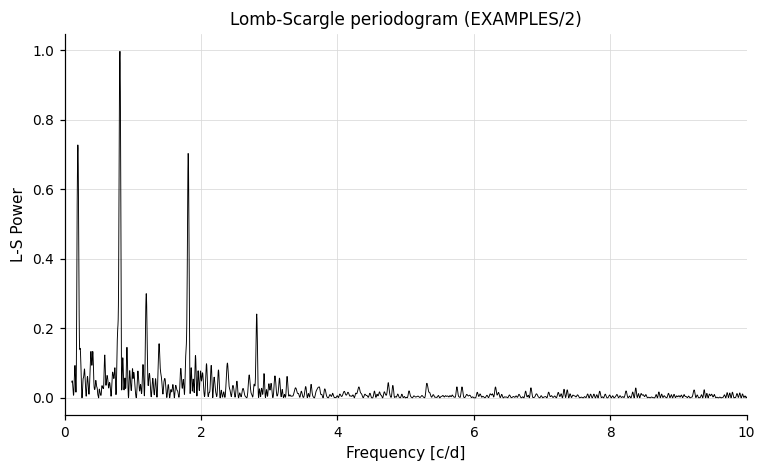
Perform a Generalized Lomb-Scargle (GLS) period search for sinusoidal signals. The search runs over frequencies from fmin = 1/maxp to fmax = 1/minp with a uniform frequency step Δf = subsample/T, where T is the time baseline. The GLS implementation of Zechmeister & Kürster (2009) allows a floating mean and heteroscedastic errors, unlike the traditional LS periodogram.
The reported statistic is LS = (χ0² − χ(f)²) / χ0², where χ0² is χ² about the weighted mean and χ(f)² is χ² about the best-fit sinusoid at frequency f. With noGLS=True the wrapper instead computes the standard un-normalized Lomb-Scargle power.
CLI equivalent: -LS.
Parameters
| Parameter | Type | Description |
|---|---|---|
minp, maxp |
float, str, numpy array, PerLC, or pd.Series |
Period search range (same units as the time column, typically days). Numeric forms are validated at construction time: minp > 0, maxp > 0, and minp < maxp; a clear ValueError is raised otherwise. Non-numeric forms (variable references, expressions, per-LC arrays) are accepted as-is since their numeric value isn't known until run time. See Variable and expression parameters; for batch per-LC values see Per-LC array parameters. |
subsample |
float, str, numpy array, PerLC, or pd.Series |
Frequency step as a fraction of 1/T (time span). Smaller values = finer resolution. Typical: 1e-3. Accepts variable names, expressions, and per-LC arrays. |
npeaks |
int |
Number of highest peaks to find and report. Default 5. |
save_periodogram |
bool, str, or Output |
Auxiliary file output. True captures as result.files["LS_periodogram_N"]; a path string writes to that directory without capturing; Output(path, capture=True) does both. See Auxiliary output files. |
noGLS |
bool |
Compute the traditional (non-generalised) Lomb-Scargle periodogram instead of the GLS form. |
whiten |
bool |
After each peak, whiten the light curve at that period before searching for the next. The SNR of each peak is computed on the whitened periodogram. |
clip, clipiter |
float, int |
Sigma-clipping parameters for the mean / RMS used in the SNR estimate. clip is the σ factor; clipiter=1 enables iterative clipping (default: iterative 5σ). |
bootstrap |
int or None |
Number of bootstrap resamples for false-alarm probability estimation. Each simulation reuses the observed times with magnitudes drawn randomly with replacement. |
maskpoints |
str or None |
Name of a mask variable; points where the variable is ≤ 0 are excluded from the periodogram. |
fixperiod_snr |
float, int, str, or None |
Evaluate the periodogram at a known period and report its significance. See fixperiod_snr — fixed-period significance. |
Output
Per peak k (1 to npeaks) and command index N:
| Column | Description |
|---|---|
LS_Period_k_N |
Best period of peak k (days). |
Log10_LS_Prob_k_N |
Log₁₀ of the formal false-alarm probability. |
LS_Periodogram_Value_k_N |
Periodogram statistic at peak k. |
LS_SNR_k_N |
Spectroscopic SNR: (LS − ⟨LS⟩) / RMS(LS). |
When fixperiod_snr is set, four additional columns are appended — see fixperiod_snr — fixed-period significance.
When save_periodogram is enabled:
| File key | Description |
|---|---|
result.files["LS_periodogram_N"] |
DataFrame with columns freq, power (and the prewhitened periodogram rows when whiten=True). |
References
Zechmeister & Kürster 2009, A&A, 496, 577 and Press et al. 1992 (Numerical Recipes) for the GLS form. For the traditional LS periodogram, also cite Lomb 1976, ApSS, 39, 447; Scargle 1982, ApJ, 263, 835; Press & Rybicki 1989, ApJ, 338, 277.
Examples
import pyvartools as vt
from pyvartools import commands as cmd

lc = vt.LightCurve.from_file("EXAMPLES/2")

# Fixed values — search periods 0.1–10 days, report top 5 peaks with whitening
result = (vt.Pipeline()
        .LS(0.1, 10.0, 0.1, npeaks=5, whiten=True, clip=5.0, clipiter=1,
           save_periodogram=True)).run(lc)
print(result.vars["LS_Period_1_0"])       # 1.23440877
print(result.vars["Log10_LS_Prob_1_0"])   # -4000.59209
pgram = result.files["LS_periodogram_0"]   # pd.DataFrame: frequency vs power

# Expression form — set period range relative to the time baseline of each LC.
# First compute min/max time with cmd.stats, then define tspan with cmd.expr,
# then pass expressions to LS.  LS is at pipeline index 2, so keys end in "_2".
result = (vt.Pipeline()
        .stats("t", "min,max")
        .expr("tspan=STATS_t_MAX_0-STATS_t_MIN_0")
        .LS("tspan/200", "tspan/2", 1e-3, npeaks=1)).run(lc)
print(result.vars["LS_Period_1_2"])       # 1.23534018

# Variable form — minp and maxp are per-star variables read from a list file.
# Each row in the list file supplies different search bounds for each LC.
# batch = pipe.run_filelist("lc_list.txt")   # list file has minp and maxp columns

# Batch: run on many light curves in parallel
lcs = [vt.LightCurve.from_file(f"EXAMPLES/{i}") for i in range(1, 11)]
batch = vt.Pipeline().LS(0.1, 10.0, 0.1, npeaks=1).run_batch(lcs, nthreads=4)
print(batch.vars[["Name", "LS_Period_1_0", "Log10_LS_Prob_1_0"]])

# fixperiod_snr — evaluate LS at a known period
lc = vt.LightCurve.from_file("EXAMPLES/2")

# Fixed number form: evaluate at period = 1.234
r = vt.Pipeline().LS(0.1, 10.0, 0.1, fixperiod_snr=1.234).run(lc)
print(r.vars["LS_SNR_PeriodFix_0"])            # SNR at period 1.234

# "ls" form: evaluate at the best peak from a prior LS search
r = (vt.Pipeline()
        .LS(0.1, 10.0, 0.1, npeaks=1)
        .LS(0.1, 10.0, 0.1, fixperiod_snr="ls")).run(lc)
print(r.vars["LS_SNR_PeriodFix_1"])            # SNR at period found by first LS

# "aov" form: evaluate LS at the best period from a prior AOV search
r = (vt.Pipeline()
        .aov(0.1, 10.0, 0.1, 0.01, npeaks=1)
        .LS(0.1, 10.0, 0.1, fixperiod_snr="aov")).run(lc)
print(r.vars["LS_SNR_PeriodFix_1"])

# "fixcolumn" form: read the period from a named per-star column
r = (vt.Pipeline()
        .LS(0.1, 10.0, 0.1, npeaks=1)
        .LS(0.1, 10.0, 0.1, fixperiod_snr="fixcolumn LS_Period_1_0")).run(lc)
print(r.vars["LS_PeriodFix_1"])
print(r.vars["Log10_LS_Prob_PeriodFix_1"])
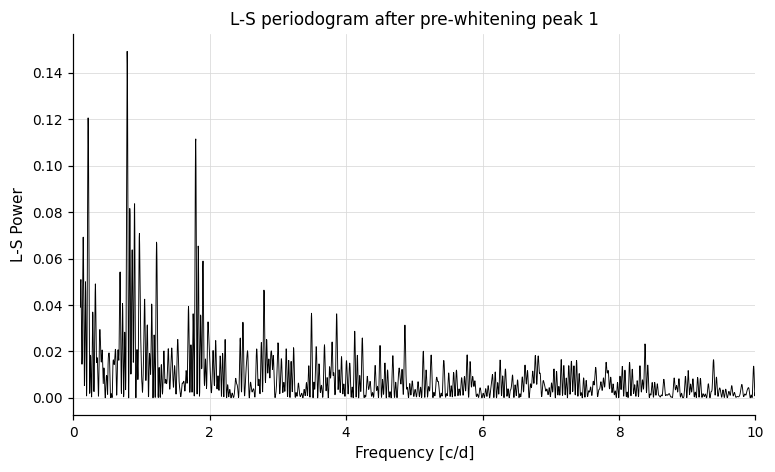
After pre-whitening peak 1 the periodogram looks like this — the dominant 1.234-day signal has been removed:
aov — Phase-Binned Analysis of Variance
Syntax
cmd.aov(minp, maxp, subsample, finetune, npeaks=5, nbin=None,
        save_periodogram=False, whiten=False, clip=None,
        clipiter=None, uselog=False, maskpoints=None, fixperiod_snr=None)
Description
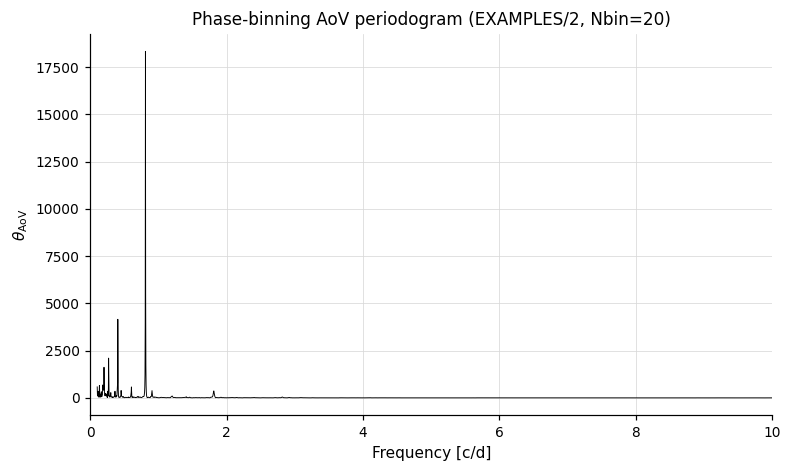
Perform an Analysis of Variance (AoV) period search using phase binning. For each trial frequency, the light curve is phase-folded and binned; the AoV statistic θ_aov measures how much variance is explained by the phase bins relative to the total variance. A high θ_aov indicates a phase-coherent signal.
The initial search uses a frequency step of subsample/T. The top peaks are refined to a resolution of finetune/T. Use AoV instead of LS when the signal is strictly periodic but non-sinusoidal (e.g. eclipsing binaries, pulsating stars) — AoV is less sensitive to the shape of the variation.
CLI equivalent: -aov.
Parameters
| Parameter | Type | Description |
|---|---|---|
minp, maxp, subsample |
float, str, numpy array, PerLC, or pd.Series |
Period range and frequency step (same forms as LS). See Variable and expression parameters; for batch per-LC values see Per-LC array parameters. |
finetune |
float or str |
Fine-tuning frequency step factor applied near peak frequencies. Accepts var/expr forms and per-LC arrays. |
npeaks |
int |
Number of peaks to report. Default 5. |
nbin |
int, str, or None |
Number of phase bins. Default None (vartools default = 8). Accepts var/expr forms and per-LC arrays. |
save_periodogram |
bool, str, or Output |
Auxiliary file output. True captures as result.files["aov_periodogram_N"]. See Auxiliary output files. |
whiten |
bool |
Whiten the light curve at each peak before searching for the next. |
clip, clipiter |
float, int |
Sigma-clipping parameters for the SNR calculation (default: iterative 5σ). |
uselog |
bool |
Use −ln(θ_aov) for the SNR statistic; also outputs the mean and RMS of −ln(θ_aov). |
maskpoints |
str or None |
Name of a mask variable; points where the variable is ≤ 0 are excluded. |
fixperiod_snr |
float, int, str, or None |
Evaluate the AoV periodogram at a known period and report its significance. See fixperiod_snr — fixed-period significance. |
Output
Per peak k (1 to npeaks) and command index N:
| Column | Description |
|---|---|
Period_k_N |
Best period of peak k (days). |
AOV_k_N |
θ_aov statistic (default; replaced by AOV_LOGSNR_k_N when uselog=True). |
AOV_SNR_k_N |
Signal-to-noise ratio in the periodogram (omitted when uselog=True). |
AOV_NEG_LN_FAP_k_N |
−ln(FAP) (formal false alarm probability). Omitted when uselog=True. |
AOV_LOGSNR_k_N |
SNR computed on −ln(θ_aov). Only when uselog=True. |
Mean_lnAOV_N |
Mean of −ln(θ_aov) (always emitted unless both whiten=True and uselog=True). |
RMS_lnAOV_N |
RMS of −ln(θ_aov) (same condition as Mean_lnAOV_N). |
Mean_lnAOV_k_N, RMS_lnAOV_k_N |
Per-peak whitened mean / RMS. Only when both whiten=True and uselog=True. |
When fixperiod_snr is set, four additional columns are appended — see fixperiod_snr — fixed-period significance.
When save_periodogram is enabled:
| File key | Description |
|---|---|
result.files["aov_periodogram_N"] |
DataFrame: frequency vs. θ_aov. |
References
Schwarzenberg-Czerny 1989, MNRAS, 241, 153 and Devor 2005, ApJ, 628, 411.
Examples
lc = vt.LightCurve.from_file("EXAMPLES/2")

result = lc.aov(0.1, 10.0, 0.1, 0.01, npeaks=5, nbin=20,
                whiten=True, clip=5.0, clipiter=1, save_periodogram=True)
print(result.vars["Period_1_0"])   # 1.23583047 — top-peak period
pgram = result.files["aov_periodogram_0"]   # pd.DataFrame: frequency vs AOV statistic

# fixperiod_snr — evaluate AOV at a known period.
# `fixperiod_snr="aov"` back-references the prior -aov call, so both steps
# must share one vartools invocation — use Pipeline here.
result = (vt.Pipeline()
        .aov(0.1, 10.0, 0.1, 0.01, npeaks=1)
        .aov(0.1, 10.0, 0.1, 0.01, fixperiod_snr="aov")).run(lc)
print(result.vars["AOV_SNR_PeriodFix_1"])
aov_harm — Multi-Harmonic Analysis of Variance
Syntax
cmd.aov_harm(nharm, minp, maxp, subsample, finetune, npeaks=5,
             save_periodogram=False, whiten=False, clip=None,
             clipiter=None, maskpoints=None, fixperiod_snr=None)
Description
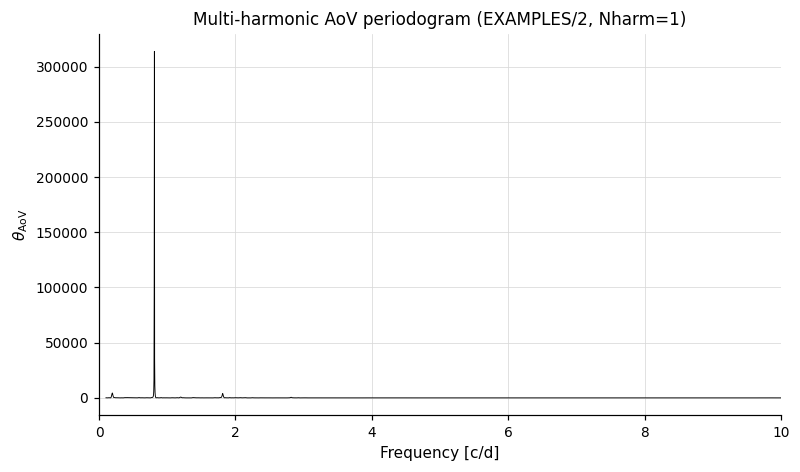
Perform an AoV period search fitting a multi-harmonic model in place of phase bins. The model signal has nharm harmonics; if nharm < 1, the number of harmonics is varied automatically to minimise the false-alarm probability (with a penalty for overfitting). All other parameters behave identically to aov.
Multi-harmonic AoV is preferable to phase-binned AoV for highly non-sinusoidal but smoothly-varying signals such as RR Lyrae, Cepheids, and W UMa systems.
CLI equivalent: -aov_harm.
Parameters
| Parameter | Type | Description |
|---|---|---|
nharm |
int, str, numpy array, PerLC, or pd.Series |
Number of harmonics in the model (≥ 1). Set to 0 or negative for automatic selection. Accepts variable names ("nharmvar"), expressions ("npeaks*2"), and per-LC arrays. |
minp, maxp, subsample, finetune |
float, str, numpy array, PerLC, or pd.Series |
Same as aov. |
npeaks |
int |
Number of peaks to report. |
save_periodogram |
bool, str, or Output |
Auxiliary file output. True captures as result.files["aov_harm_periodogram_N"]. |
whiten, clip, clipiter, maskpoints |
— | Same as aov. |
fixperiod_snr |
float, int, str, or None |
Evaluate the multi-harmonic AoV periodogram at a known period. See fixperiod_snr — fixed-period significance. |
Output
Per peak k (1 to npeaks) and command index N:
| Column | Description |
|---|---|
Period_k_N |
Best period of peak k (days). |
AOV_HARM_k_N |
Multi-harmonic AoV statistic. Only when nharm > 0. |
AOV_HARM_NEG_LOG_FAP_k_N |
−log(FAP). Always emitted; when nharm <= 0 (auto-select) it carries the periodogram value at the peak instead of the AoV statistic. |
AOV_HARM_NHARM_k_N |
Number of harmonics chosen at peak k. Only when nharm <= 0 (automatic harmonic selection). |
AOV_HARM_SNR_k_N |
Signal-to-noise ratio in the periodogram. |
Mean_AOV_HARM_N |
Mean of the AoV-harm statistic (always emitted unless whiten=True). |
RMS_AOV_HARM_N |
RMS of the AoV-harm statistic (same condition as Mean_AOV_HARM_N). |
Mean_AOV_HARM_k_N, RMS_AOV_HARM_k_N |
Per-peak whitened mean / RMS. Only when whiten=True. |
When fixperiod_snr is set, four additional columns are appended — see fixperiod_snr — fixed-period significance.
When save_periodogram is enabled:
| File key | Description |
|---|---|
result.files["aov_harm_periodogram_N"] |
DataFrame: frequency vs. multi-harmonic AoV statistic. |
References
Schwarzenberg-Czerny 1996, ApJ, 460, L107.
Examples
lc = vt.LightCurve.from_file("EXAMPLES/2")

result = lc.aov_harm(1, 0.1, 10.0, 0.1, 0.01, npeaks=2,
                     whiten=True, clip=5.0, clipiter=1, save_periodogram=True)
print(result.vars["Period_1_0"])   # 1.23533969 — top-peak period
pgram = result.files["aov_harm_periodogram_0"]

# fixperiod_snr — evaluate AOV_HARM at a known period (numeric, or back-refs
# to a prior -aov or -Injectharm call inside the same Pipeline).
result = lc.aov_harm(2, 0.1, 10.0, 0.1, 0.01, fixperiod_snr=1.23440877)
print(result.vars["AOV_HARM_SNR_PeriodFix_0"])
PDM — Phase Dispersion Minimization
Syntax
cmd.PDM(variant, minp, maxp, subsample, finetune, *,
        npeaks=5, nbin=None, nc=None, dphi=None,
        save_periodogram=False, clip=None, clipiter=None,
        noerr=False, whiten=False,
        fixperiod_snr=None, bootstrap=None, maskpoints=None)
Description
Perform a Phase Dispersion Minimization period search. For each trial frequency the light curve is phase-folded and a statistic θ ∈ [0, 1] measures the residual dispersion against a phase-fold model. A signal at the correct period drives θ toward 0; pure noise has θ near 1. The first argument selects one of five variants:
variant |
Model | Notes |
|---|---|---|
"step" |
Per-bin mean over nbin fixed phase bins (Stellingwerf 1978). |
Classic PDM. |
"linterp" |
Linear interpolation between adjacent bin means (cuvarbase default). | Smoother periodogram than step for the same nbin. |
"multicover" |
Average of nc phase-shifted nbin-bin sets. |
Reduces bin-edge sensitivity. Schwarzenberg-Czerny 1997 explicitly notes that no analytic FAP exists for nc > 1; the reported FAP uses the single-cover formula and should be treated as approximate. |
"tophat" |
Per-point weighted mean of phase-neighbours inside \|Δφ\| ≤ dphi. |
Binless. Costs O(N²) per trial period. |
"gauss" |
Per-point weighted mean with Gaussian phase kernel of sigma dphi. |
Smoother binless variant; same O(N²) cost. |
PDM is most useful for non-sinusoidal but smoothly-varying signals (eclipsing binaries, RR Lyrae, Cepheids).
CLI equivalent: -PDM.
Parameters
| Parameter | Type | Description |
|---|---|---|
variant |
str |
Required. One of "step", "linterp", "multicover", "tophat", "gauss". |
minp, maxp, subsample |
float, str, numpy array, PerLC, or pd.Series |
Period range and frequency step (same forms as LS). The coarse-grid frequency step is Δf = subsample / T, where T is the time-span of the light curve. See Variable and expression parameters; for batch per-LC values see Per-LC array parameters. |
finetune |
float or str |
Fine-tuning frequency step factor applied near peak frequencies. The fine-tune step is Δf_fine = finetune / T. |
npeaks |
int |
Number of peaks to report. Default 5. |
nbin |
int, str, or None |
Phase-bin count for step/linterp (or bins-per-cover for multicover). Default None (in this case use the internal vartools default value of 8). Rejected for binless variants. |
nc |
int, str, or None |
Number of phase-shifted bin sets for multicover only. Default None (in this case use the internal vartools default value of 2). Rejected for other variants. |
dphi |
float, str, or None |
Phase-window half-width (tophat) or kernel sigma (gauss). Default None (in this case use the internal vartools default value of 0.05). Rejected for binned variants. |
save_periodogram |
bool, str, or Output |
Auxiliary file output. True captures as result.files["pdm_periodogram_N"]. When whiten=True, the file contains one column per whitening cycle. See Auxiliary output files. |
clip, clipiter |
float, int |
σ-clipping factor and iterate-flag for the SNR noise estimate. Default: iterative 5σ. |
noerr |
bool |
Use uniform point weights instead of 1/σ². |
whiten |
bool |
Subtract the step-bin phase model at each peak before searching for the next. |
fixperiod_snr |
float, int, str, or None |
Evaluate the PDM periodogram at a known period. Accepts numeric values; "aov" / "ls" / "pdm" / "injectharm" back-references to the most recent prior period-finder of that type; "fixcolumn <name>"; or "list" (with optional "column N"). See fixperiod_snr — fixed-period significance. |
bootstrap |
int or None |
If set, recalibrate the FAP empirically from this many shuffled-light-curve trials. Bootstrap can be used to calibrate the FAP; in practice it may be too slow for large analysis projects. |
maskpoints |
str or None |
Name of a mask vector; points where the variable is ≤ 0 are excluded. |
Constructor-time validation rejects unknown variant values and the variant/parameter mismatches above; misuse fails at pipeline-build time rather than at vartools-invocation time.
Output
Per peak k (1 to npeaks) and command index N:
| Column | Description |
|---|---|
PDM_Period_k_N |
Best period of peak k (days). |
PDM_Theta_k_N |
θ statistic (lower is better; 1 = random, 0 = perfectly coherent). |
PDM_SNR_k_N |
(θ_mean − θ_peak) / θ_rms. PDM SNR is a known-poor significance statistic — it is reported for consistency with aov; for thresholding prefer PDM_NEG_LN_FAP_k_N. |
PDM_NEG_LN_FAP_k_N |
−ln(FAP). Schwarzenberg-Czerny 1997 analytic Beta distribution with an effective-trials-factor correction by default; empirical CDF from the bootstrap distribution when bootstrap is set. |
Mean_PDM_Theta_N / RMS_PDM_Theta_N |
Periodogram mean / RMS used for the SNR. Replaced by per-cycle Mean_PDM_Theta_k_N / RMS_PDM_Theta_k_N when whiten=True. |
When fixperiod_snr is set, four additional columns are appended — see fixperiod_snr — fixed-period significance.
When save_periodogram is enabled:
| File key | Description |
|---|---|
result.files["pdm_periodogram_N"] |
DataFrame: period vs. θ. With whiten=True, one column per cycle. |
References
Stellingwerf 1978, ApJ, 224, 953; Schwarzenberg-Czerny 1997, ApJ, 489, 941; Zalian, Chadid & Stellingwerf 2014, MNRAS, 440, 68. The linterp variant follows the implementation in cuvarbase (package developed by John Hoffman; the linterp PDM contribution was written by Attila Bodi).
Examples
lc = vt.LightCurve.from_file("EXAMPLES/2")

# linterp variant (cuvarbase-style smoothing), top peak, periodogram captured.
result = lc.PDM("linterp", 0.1, 10.0, 0.1, 0.01, npeaks=1, nbin=20,
                save_periodogram=True)
print(round(result.vars["PDM_Period_1_0"], 4))    # 1.2348 -- dominant signal

# Multicover variant -- averages 8-bin theta over 4 phase-shifted covers.
result = lc.PDM("multicover", 0.1, 10.0, 0.1, 0.01,
                npeaks=1, nbin=8, nc=4)
print(round(result.vars["PDM_Period_1_0"], 4))

# Binless tophat (narrow period range -- O(N^2) cost per trial frequency).
result = lc.PDM("tophat", 0.5, 2.0, 0.5, 0.05, npeaks=1, dphi=0.05)
print(round(result.vars["PDM_Period_1_0"], 4))

# fixperiod_snr -- back-reference the prior -aov call to evaluate PDM at
# its peak period.  Both steps must share one vartools invocation; use
# Pipeline to chain.
result = (vt.Pipeline()
        .aov(0.1, 10.0, 0.1, 0.01)
        .PDM("linterp", 0.1, 10.0, 0.1, 0.01, npeaks=1,
             fixperiod_snr="aov")).run(lc)
print(round(result.vars["PDM_Theta_PeriodFix_1"], 4))
FTP — Fast Template Periodogram
Syntax
cmd.FTP(template_source, minp, maxp, subsample, finetune, *,
        template_file=None,
        lc_path=None, lc_format=None, t_col=None, mag_col=None, err_col=None,
        period=None, nharm=None,
        cn=None, sn=None,
        filelist_column=None,
        npeaks=5, save_periodogram=False,
        clip=None, clipiter=None,
        noerr=False, posamponly=False, whiten=False,
        fixperiod_snr=None, bootstrap=None, maskpoints=None,
        method=None, sums=None)
Description
Perform a Fast Template Periodogram (FTP) search. FTP is a non-linear extension of the generalised Lomb-Scargle periodogram (Hoffman, VanderPlas, Hartman & Bakos 2021) that fits a known periodic template shape M(φ) = Σₙ₌₁..ₕ [cₙ cos(n φ) + sₙ sin(n φ)] at each trial period instead of a single sinusoid. The reported FTP_Power_k_N ∈ [0, 1] is the fraction of the centred chi-square variance explained by the best-fit template; 1 = exact fit. FTP is most useful when the signal shape is known a priori (RR Lyrae, Cepheids, or any signal whose Fourier coefficients can be reliably pre-computed).
The template_source argument selects how the template is sourced. Each mode requires its own set of mode-specific keyword arguments; mixing kwargs across modes is rejected at construction time.
template_source |
Required kwargs | Description |
|---|---|---|
"file" |
template_file |
Read cₙ, sₙ from a two-column text file. H is inferred from the row count. |
"fitlc" |
lc_path, lc_format, t_col, mag_col, err_col, nharm, period |
Build the template by fitting a Fourier series of total order nharm + 1 to the LC at lc_path at fixed period. ASCII columns are 1-indexed ints; FITS columns are name strings. Use err_col=0 (ASCII) or err_col="none" (FITS) for an unweighted fit. |
"inline" |
cn, sn |
Parallel lists of length nharm + 1 (nharm is inferred from len(cn)). Each entry is a number or a bare-identifier / expression string (var/expr semantics, evaluated per LC). |
"filelist" |
(filelist_column optional) |
Read each LC's template path from a column of the -l input list. Without filelist_column, the next available column is used. Each LC's template is loaded lazily, so H can differ across the list. |
Following the -harmonicfilter / -Injectharm convention, nharm counts harmonics above the fundamental — so nharm=0 is a pure-fundamental (sinusoidal) template with H = 1, nharm=1 adds a 2nd harmonic for H = 2, etc.
The default method="auto" (or None) selects the polynomial fast path for H ≤ 2 and the brute-force grid scan otherwise — the polynomial path is faster only at very low harmonic counts. The default sums="auto" selects NFFT-batched summation when vartools was built with --with-nfft.
CLI equivalent: -FTP.
Parameters
| Parameter | Type | Description |
|---|---|---|
template_source |
str |
Required. One of "file", "fitlc", "inline", "filelist". |
minp, maxp, subsample, finetune |
float, str, numpy array, PerLC, or pd.Series |
Period range and frequency-step factors (same forms as LS). |
template_file |
str |
file mode only: path to the two-column cₙ sₙ text file. |
lc_path |
str |
fitlc mode only: path to the LC from which the template is built. |
lc_format |
"ascii" or "fits" |
fitlc mode only: format of lc_path. |
t_col, mag_col, err_col |
int or str |
fitlc mode only: ASCII column numbers (1-indexed ints; err_col=0 for unweighted) or FITS column names (err_col="none" for unweighted). |
period |
float |
fitlc mode only: fixed period at which the template Fourier series is fit. Numeric only — the vartools C parser uses atof, so var / expr are not accepted on this slot. |
nharm |
int |
fitlc / inline modes: harmonics above the fundamental (template order H = nharm + 1). In inline mode nharm is inferred from len(cn) and only needs to be passed if the caller wants the validation cross-check. |
cn, sn |
list |
inline mode only: length-(nharm + 1) lists of the c_n and s_n coefficients. Each entry is a number or a string (bare identifier → var, anything else → expr). |
filelist_column |
int or None |
filelist mode only: 1-indexed column of the -l input list holding each LC's template path. |
npeaks |
int |
Number of peaks to report. Default 5. |
save_periodogram |
bool, str, or Output |
Auxiliary file output. True captures as result.files["ftp_periodogram_N"]. With whiten=True, one column per cycle. See Auxiliary output files. |
clip, clipiter |
float, int |
σ-clipping factor and iterate-flag for the SNR noise estimate. Default: iterative 5σ. |
noerr |
bool |
Use uniform point weights instead of 1/σ². |
posamponly |
bool |
Skip negative-amplitude solutions during the search (FTP_NegAmp candidates rejected; the periodogram value becomes the best positive-amplitude fit at each frequency). |
whiten |
bool |
After each peak, subtract θ₁·M(ω t − θ₂) + θ₃ from the LC and recompute the periodogram for the next peak. |
fixperiod_snr |
float, int, str, or None |
Evaluate the FTP statistic at a known period. Accepts numeric values; "aov" / "ls" / "pdm" / "ftp" / "injectharm" back-references; "fixcolumn <name>"; or "list" (with optional "column N"). Evaluation is against the original light curve even when whiten=True. |
bootstrap |
int or None |
If set, calibrate the FAP empirically from this many shuffled-LC trials. Adds FTP_NEG_LN_FAP_k_N to the output. |
maskpoints |
str or None |
Name of a mask vector; points where the variable is ≤ 0 are excluded. |
method |
"auto", "brute", "poly", "verify", or None |
Per-frequency optimisation strategy. auto (the default) picks poly for H ≤ 2, else brute. verify runs both and emits a stderr comparison summary. |
sums |
"auto", "direct", "nfft", or None |
Per-LC summation strategy. auto (the default) picks nfft when vartools was built with --with-nfft. |
Constructor-time validation rejects unknown template_source, missing mode-specific kwargs, mixing kwargs across modes, mismatched nharm vs len(cn), unknown method / sums values, and bootstrap < 1; misuse fails at pipeline-build time rather than at vartools-invocation time.
Output
Per peak k (1 to npeaks) and command index N:
| Column | Description |
|---|---|
FTP_Period_k_N |
Best period of peak k (days). |
FTP_Power_k_N |
FTP power statistic ∈ [0, 1]; higher is better, 1 = exact template fit. |
FTP_SNR_k_N |
(P_peak − P_mean) / P_rms from the clipped periodogram. |
FTP_NegAmp_k_N |
1 if the best fit had θ₁ < 0 (a flipped template — generally suspect); 0 otherwise. |
FTP_Theta_k_N |
Best-fit phase shift θ₂ in radians. |
Mean_FTP_Power_N / RMS_FTP_Power_N |
Periodogram mean / RMS used for the SNR (replaced by per-cycle Mean_FTP_Power_k_N / RMS_FTP_Power_k_N when whiten=True). |
FTP_NEG_LN_FAP_k_N |
−ln(FAP) either from the bootstrap distribution if bootstrap is set, or estimated from the GLS Beta analytic formula. |
When fixperiod_snr is set, six additional columns are appended: FTP_PeriodFix_N, FTP_Power_PeriodFix_N, FTP_SNR_PeriodFix_N, FTP_NegAmp_PeriodFix_N, FTP_Theta_PeriodFix_N, FTP_NEG_LN_FAP_PeriodFix_N.
When save_periodogram is enabled:
| File key | Description |
|---|---|
result.files["ftp_periodogram_N"] |
DataFrame: period vs. FTP power. With whiten=True, one column per cycle. |
References
Hoffman, J., et al. 2021, arXiv:2101.12348. Reference Python implementation: PrincetonUniversity/FastTemplatePeriodogram (package developed by John Hoffman).
Examples
lc_ftp = vt.LightCurve.from_file("EXAMPLES/2")

# Inline H=1 template (pure cosine) -- the degenerate LS-equivalent case.
result = lc_ftp.FTP("inline", 0.1, 10.0, 0.1, 0.01,
                    cn=[1.0], sn=[0.0], npeaks=1)
print(round(result.vars["FTP_Period_1_0"], 4))    # 1.2353 -- dominant signal
print(round(result.vars["FTP_Power_1_0"], 3))     # ~0.997 (near-perfect fit)

# fitlc mode: build a 6-harmonic template by fitting the LC itself at
# the known period, then search the same LC with whitening between peaks.
result = lc_ftp.FTP("fitlc", 0.1, 10.0, 0.1, 0.01,
                    lc_path="EXAMPLES/2", lc_format="ascii",
                    t_col=1, mag_col=2, err_col=3,
                    nharm=5, period=1.235, npeaks=2, whiten=True)
print(round(result.vars["FTP_Period_1_0"], 4))

# fixperiod_snr -- back-reference a prior LS step to evaluate the
# FTP statistic at LS's peak period.
result = (vt.Pipeline()
        .LS(0.1, 10.0, 0.1)
        .FTP("inline", 0.1, 10.0, 0.1, 0.01,
             cn=[1.0], sn=[0.0], npeaks=1,
             fixperiod_snr="ls")).run(lc_ftp)
print(round(result.vars["FTP_Power_PeriodFix_1"], 3))
MatchedFilter — Template matched-filter transient search
Syntax
cmd.MatchedFilter(template, support_halfwidth, mode, signs,
                  npeaks=3, save_matchfile=False, *,
                  tau=None,
                  tau_rise=None, tau_decay=None,
                  tfwhm=None,
                  sigma=None,
                  width=None,
                  rise=None, flat=None, fall=None,
                  template_file=None,
                  expression=None, expr_varname=None,
                  min_separation=None,
                  whiten=False,
                  maskpoints=None)
Description
Run an inverse-variance matched filter to detect template-shaped transients or features (flares, transits, eclipses, bumps). Unlike the periodogram commands above, the matched filter does not search a period grid — it scans the LC for single-shot occurrences of a template-shaped feature. At each trial centre τ (chosen from the LC's own time array) the algorithm fits
with the constant offset c absorbed as a local nuisance baseline within the support window, so the LC's absolute magnitude does not have to be pre-subtracted. The best-fit amplitude â(τ) is the perturbation in light-curve units at the peak, and the signed SNR is positive for matches sharing the template orientation, negative for inverted matches.
The template argument selects how the template is sourced:
template |
Required kwargs | Description |
|---|---|---|
"exp" |
tau |
Single exponential decay starting at s = 0. |
"doubleexp" |
tau_rise, tau_decay |
Rise-then-decay profile, peak-normalised. |
"flare" |
tfwhm |
Davenport+2014 empirical M-dwarf flare template. |
"gauss" |
sigma |
Gaussian template. |
"box" |
width |
Box template, total width width. |
"triangle" |
width |
Symmetric V at s = 0, total width width. |
"trap" |
rise, flat, fall |
Trapezoid: linear rise + flat top + linear fall. |
"file" |
template_file |
2-column (t, amplitude) ASCII file; linear interpolation between rows. |
"expr" |
expression (expr_varname="s" by default) |
Analytic vartools expression in a template-relative time variable. |
In all cases support_halfwidth is an outer truncation window: g(s) = 0 for |s| > support_halfwidth, regardless of the template's intrinsic shape.
The mode keyword selects the algorithm: "window" is exact for any time sampling and supports heteroscedastic σ; "nfft" is an NFFT-batched evaluation (requires --with-nfft) that assumes homoscedastic σ (median) and develops a few-percent leakage near support boundaries for sharp-edged templates. Prefer "window" when sharp shapes or per-point σ matter.
The signs keyword sets the polarity filter applied to peak ranking and the per-LC noise estimate: "positive" for bumps, "negative" for inverted matches, "both" to rank by |SNR|.
CLI equivalent: -matchedfilter.
Parameters
| Parameter | Type | Description |
|---|---|---|
template |
str |
Required. One of "exp", "doubleexp", "flare", "gauss", "box", "triangle", "trap", "file", "expr". |
support_halfwidth |
float, str, numpy array, PerLC, or pd.Series |
Outer truncation half-width. Accepts var/expr forms. |
mode |
"window" or "nfft" |
Required. |
signs |
"both", "positive", or "negative" |
Required. |
npeaks |
int |
Number of peaks to report. Default 3. |
save_matchfile |
bool, str, or Output |
Auxiliary (t, SNR, amplitude) surface output. True captures as result.files["matchfile_N"]. |
tau, tau_rise, tau_decay, tfwhm, sigma, width, rise, flat, fall |
float, str, numpy array, PerLC, or pd.Series |
Template-specific scalar parameter(s). Each accepts the var/expr forms. |
template_file |
str |
"file" mode only: path to the 2-column ASCII template file. |
expression |
str |
"expr" mode only: vartools-syntax analytic expression for g(s). Must not reference LC-vector variables. |
expr_varname |
str |
"expr" mode only: name of the template-relative time variable in expression. Default "s". |
min_separation |
float, str, … |
Optional mask half-width around each peak. Default = support_halfwidth. |
whiten |
bool |
Iteratively subtract â · g(t − τ_k) from a working copy of the LC between peaks. The original LC is restored on return. |
maskpoints |
str or None |
Name of a mask vector; points where the variable is ≤ 1e-7 are excluded. |
Constructor-time validation rejects unknown template / mode / signs, missing mode-specific kwargs, mixing kwargs across template kinds, and npeaks ≤ 0.
Output
Per peak k (1 to npeaks) and command index N:
| Column | Description |
|---|---|
MatchedFilter_Time_k_N |
Trial centre τ of the k-th peak (one of the LC's data times). |
MatchedFilter_SNR_k_N |
Signed SNR at the peak. |
MatchedFilter_Amplitude_k_N |
Best-fit amplitude â at the peak, in light-curve units. |
MatchedFilter_Mean_SNR_N / MatchedFilter_RMS_SNR_N |
Mean and RMS of SNR(τ) over the sign-filtered trial grid. |
When save_matchfile is enabled:
| File key | Description |
|---|---|
result.files["matchfile_N"] |
DataFrame: trial t, SNR(t), amplitude(t). |
References
Cite Davenport, J. R. A. et al. 2014, ApJ, 797, 122 when using the "flare" named-template kind. The matched-filter formulation itself is standard; Turin, G. L. 1960, IRE Transactions on Information Theory, IT-6, 311 is the canonical reference.
Examples
import numpy as np

# Build a clean white-noise LC with an injected Gaussian feature.
rng = np.random.default_rng(0)
t = np.linspace(0.0, 30.0, 500)
t0 = float(t[100])           # nail the injection to a data time
sigma_g = 0.3
depth   = -0.05
mag = depth * np.exp(-0.5 * ((t - t0) / sigma_g) ** 2) + rng.normal(0, 0.01, 500)
err = np.full_like(t, 0.01)
lc_mf = vt.LightCurve.from_arrays(t, mag, err, name="injected")

# Named Gaussian template, signs="negative" (looking for dips).
result = lc_mf.MatchedFilter("gauss", 3.0, "window", "negative",
                              sigma=sigma_g, npeaks=1)
print(round(float(result.vars["MatchedFilter_SNR_1_0"]), 1))
print(round(float(result.vars["MatchedFilter_Amplitude_1_0"]), 4))
print(round(float(result.vars["MatchedFilter_Time_1_0"]) - t0, 4))

# Same recovery via the expression-template mode -- byte-identical
# to the named-gauss result above on this data.
result = lc_mf.MatchedFilter("expr", 3.0, "window", "negative",
                              expression=f"exp(-s*s/{2.0 * sigma_g**2})",
                              npeaks=1)
print(round(float(result.vars["MatchedFilter_Amplitude_1_0"]), 4))

# Trapezoidal template, with min_separation and whitening between peaks.
result = lc_mf.MatchedFilter("trap", 1.0, "window", "negative",
                              rise=0.1, flat=0.3, fall=0.1,
                              npeaks=2, min_separation=2.0, whiten=True)
print(round(float(result.vars["MatchedFilter_SNR_1_0"]), 1))
BLS — Box-fitting Least Squares
Syntax
cmd.BLS(minper, maxper, rmin=0.01, rmax=0.1, nbins=200,
        timezone=0, npeaks=1, subsample=1.0, nfreq=None,
        qmin=None, qmax=None,
        density_mode=False, stellar_density=None,
        min_exp_dur_frac=0.5, max_exp_dur_frac=1.5,
        df=None, extraparams=False, nobinnedrms=True,
        freq_grid=None, adjust_qmin=False, reduce_nbins=False,
        reportharmonics=False, mergepeakdf=None, mergepeakdf_transit=None,
        save_periodogram=False, save_model=False,
        save_phcurve=False, save_jdcurve=False,
        ophcurve_phmin=0, ophcurve_phmax=1, ophcurve_phstep=0.005,
        ojdcurve_jdstep=0.02,
        correct_lc=False, fittrap=False, maskpoints=None)
Description
Run the Box-Least Squares (BLS) transit search algorithm of Kovács, Zucker & Mazeh (2002). BLS searches for periodic box-shaped (or trapezoidal) dips consistent with a transiting companion. The search is performed over a grid of trial periods and phase bins.
The transit-duration grid can be specified three ways:
rmode (default): passrmin/rmaxas the minimum/maximum stellar radius in solar radii. The fractional-duration range for each period is derived fromq = 0.076 · R^(2/3) · P^(-2/3).qmode: passqmin/qmaxdirectly as the fractional transit duration (ingress-to-egress fraction).- density mode: set
density_mode=Trueand supplystellar_density(g/cm³) plusmin_exp_dur_frac/max_exp_dur_fracto bracket the expected circular-orbit duration.
The trial-frequency grid can also be specified three ways, and these are mutually exclusive — pass exactly one of subsample, nfreq, or df:
optimalmode: use the Ofir (2014) frequency sampling optimal for transit search, controlled bysubsample(oversampling factor; default1.0). Available only withdensity_mode=True, since the spacing depends on the expected transit duration.nfreqmode: passnfreq=Nto use a fixed number of trial frequencies on a uniform grid.dfmode: passdf=Δfto set a fixed frequency step on a uniform grid.
When density_mode=True, optimal mode is the default unless nfreq or df is also set; in r/q duration mode, nfreq or df is required (the wrapper raises a ValueError at construction time if both are omitted).
CLI equivalent: -BLS.
Parameters
| Parameter | Type | Description |
|---|---|---|
minper, maxper |
float, str, numpy array, PerLC, or pd.Series |
Period search range (days). See Variable and expression parameters; for batch per-LC values see Per-LC array parameters. |
rmin, rmax |
float or str |
r-mode duration bounds (default mode). Ignored when qmin/qmax are set. |
qmin, qmax |
float, str, or None |
q-mode duration bounds (fractional transit duration). When set, emits "q" qmin qmax instead of "r" rmin rmax. |
nbins |
int or str |
Number of phase bins (≥ 2/qmin). Accepts var/expr/PerLC forms. |
timezone |
float |
Time-zone offset (0 for HJD/BJD); affects the single-night Δχ² fraction. |
npeaks |
int |
Number of transit candidates to report. |
subsample |
float or str |
Oversampling factor for the Ofir (2014) optimal frequency-sampling method. Used only when density_mode=True and neither nfreq nor df is set. Mutually exclusive with nfreq and df. |
nfreq |
int, str, or None |
Fixed number of trial frequencies (uniform grid). Mutually exclusive with subsample and df. |
density_mode |
bool |
Use stellar density to set transit-duration bounds. Required for the Ofir (2014) optimal grid. |
stellar_density |
float, str, or None |
Stellar density (g/cm³) for density mode. |
min_exp_dur_frac, max_exp_dur_frac |
float or str |
Expected-duration fractions for density mode (default 0.5 and 1.5). |
df |
float, str, or None |
Fixed frequency step (uniform grid). Mutually exclusive with subsample and nfreq. |
extraparams |
bool |
Include additional false-positive diagnostic columns in the output. |
nobinnedrms |
bool |
Adjust the way in which the BLS_SN statistic is calculated. The default mode of True yields a faster and more robust process. Set to False to recover the historical VARTOOLS behavior. |
freq_grid |
str or None |
"stepP" for uniform period sampling, "steplogP" for log-uniform. |
adjust_qmin |
bool |
Adaptively increase qmin at each frequency to max(qmin, mindt·f). |
reduce_nbins |
bool |
(With adjust_qmin=True) adaptively reduce nbins at each frequency. |
reportharmonics |
bool |
Report period harmonics (½, ⅓, …) as additional candidates. |
mergepeakdf |
float or None |
Fixed factor for the peak-merge frequency resolution Df = mergepeakdf / T (T = time baseline). Default (None) uses Df = 1/T, the Rayleigh resolution; mergepeakdf=1.0 is equivalent. Mutually exclusive with mergepeakdf_transit. |
mergepeakdf_transit |
float or None |
Transit-aware multiplier: Df = mergepeakdf_transit · q / T with q the per-candidate fitted transit width. Resolves peaks on the finer scale a box transit smears over; a value of order a few is recommended. Mutually exclusive with mergepeakdf. |
save_periodogram |
bool, str, or Output |
BLS spectrum file. True captures as result.files["BLS_periodogram_N"]. See Auxiliary output files. |
save_model |
bool, str, or Output |
Best-fit transit model. True captures as result.files["BLS_model_N"]. |
save_phcurve |
bool, str, or Output |
Phase-folded model curve. True captures as result.files["BLS_phcurve_N"]. |
ophcurve_phmin, ophcurve_phmax, ophcurve_phstep |
float |
Phase range and step for the phase-curve output. Defaults 0.0, 1.0, 0.005. |
save_jdcurve |
bool, str, or Output |
JD-sampled model curve. True captures as result.files["BLS_jdcurve_N"]. |
ojdcurve_jdstep |
float |
Time step (days) for the JD-curve output. Default 0.02. |
correct_lc |
bool |
Subtract the best-fit transit from the LC before passing to the next command. |
fittrap |
bool |
Fit a trapezoidal rather than box-shaped transit at each peak. Adds BLS_Qingress_k_N and BLS_OOTmag_k_N to the output. |
maskpoints |
str or None |
Mask variable; points with maskvar ≤ 0 are excluded from the BLS spectrum. |
Output
Per peak k (1 to npeaks) and command index N:
| Column | Description |
|---|---|
BLS_Period_k_N |
Best period of peak k (days). |
BLS_Tc_k_N |
Mid-transit epoch. |
BLS_SN_k_N |
Signal-to-noise ratio in the BLS spectrum. |
BLS_SR_k_N |
BLS spectral residual. |
BLS_SDE_k_N |
Signal detection efficiency. |
BLS_Depth_k_N |
Transit depth (magnitudes). |
BLS_Qtran_k_N |
Fractional transit duration q. |
BLS_i1_k_N, BLS_i2_k_N |
Phases of transit ingress and egress. |
BLS_deltaChi2_k_N |
Δχ² of the best-fit transit. |
BLS_fraconenight_k_N |
Fraction of Δχ² from a single night. |
BLS_Npointsintransit_k_N |
Points within the transit window. |
BLS_Ntransits_k_N |
Number of observed transits. |
BLS_Npointsbeforetransit_k_N, BLS_Npointsaftertransit_k_N |
Points immediately before/after each transit (used for diagnostics). |
BLS_Rednoise_k_N |
Estimated red noise level. |
BLS_Whitenoise_k_N |
Estimated white noise level. |
BLS_SignaltoPinknoise_k_N |
Signal-to-pink-noise ratio. |
BLS_Qingress_k_N, BLS_OOTmag_k_N |
Ingress fraction and out-of-transit magnitude. Only when fittrap=True. |
BLS_Period_invtransit_N |
Period of the largest inverted (anti-transit) Δχ² peak — diagnostic for symmetric systematics. |
BLS_deltaChi2_invtransit_N |
Δχ² of the inverse-transit peak. |
BLS_MeanMag_N |
Out-of-transit mean magnitude. |
When extraparams=True is set, the following additional per-peak columns are appended: BLS_SRSum_k_N, BLS_ResSig_k_N, BLS_DipSig_k_N, BLS_SRShift_k_N, BLS_SRSig_k_N, BLS_SRShiftSNR_k_N, BLS_DSP_k_N, BLS_DSPG_k_N, BLS_FreqLow_k_N, BLS_FreqHigh_k_N, BLS_LogProb_k_N, BLS_PeakArea_k_N, BLS_PeakMean_k_N, BLS_PeakDev_k_N, BLS_LombLog_k_N, BLS_NTV_k_N, BLS_GDSP_k_N, BLS_OOTSig_k_N, BLS_TRSig_k_N, BLS_OOTDFTF_k_N, BLS_OOTDFTA_k_N, BLS_BinSN_k_N, BLS_MaxPhaseGap_k_N, BLS_Dip1DblPeriod_k_N, BLS_Dip2DblPeriod_k_N, BLS_DelChi2DblPeriod_k_N, BLS_SRSecondary_k_N, BLS_SRSumSecondary_k_N, BLS_QSecondary_k_N, BLS_EpochSecondary_k_N, BLS_HSecondary_k_N, BLS_LSecondary_k_N, BLS_DepthSecondary_k_N, BLS_NPointsInTransitSecondary_k_N, BLS_NTransitsSecondary_k_N, BLS_SignaltoPinknoiseSecondary_k_N, BLS_DeltaChi2TransitSecondary_k_N, BLS_BinSNSecondary_k_N, BLS_PhaseOffsetSecondary_k_N, BLS_HarmMean_k_N, BLS_fundA_k_N, BLS_fundB_k_N, BLS_harmA_k_N, BLS_harmB_k_N, BLS_HarmAmp_k_N, BLS_HarmDeltaChi2_k_N.
When the corresponding save_* keyword is set:
| File key | Description |
|---|---|
result.files["BLS_periodogram_N"] |
DataFrame: frequency vs. BLS spectral residual. |
result.files["BLS_model_N"] |
DataFrame: phased data with best-fit transit model overlaid. |
result.files["BLS_phcurve_N"] |
DataFrame: model phase curve sampled on [ophcurve_phmin, ophcurve_phmax]. |
result.files["BLS_jdcurve_N"] |
DataFrame: model curve sampled in JD space at ojdcurve_jdstep. |
References
Kovács, Zucker & Mazeh 2002, A&A, 391, 369. For the Ofir (2014) optimal frequency sampling (used in density mode), cite Ofir 2014, A&A, 561, A138.
Examples
lc = vt.LightCurve.from_file("EXAMPLES/3.transit")

# Fixed fractional duration (r mode) — simplest default.
result = lc.BLS(0.1, 20.0, rmin=0.01, rmax=0.1,
                nbins=200, nfreq=10000, npeaks=1, fittrap=True,
                save_periodogram=True, save_model=True)
print(result.vars["BLS_Period_1_0"])    # 2.12334706
print(result.vars["BLS_SN_1_0"])        # signal-to-noise
print(result.vars["BLS_SDE_1_0"])       # signal detection efficiency
pgram = result.files["BLS_periodogram_0"]   # pd.DataFrame: frequency vs BLS power

# Q mode (specify min/max fractional transit duration directly)
result2 = lc.BLS(0.1, 20.0, qmin=0.01, qmax=0.1,
                 nbins=200, nfreq=10000, npeaks=3)

# Density mode (recommended when stellar density is known).
# stellar_density in g/cm^3; min/max_exp_dur_frac scale the expected duration.
# Use a wide enough frac range — narrow ranges can exclude all trial periods.
result3 = lc.BLS(0.1, 20.0,
                 density_mode=True, stellar_density=1.4,
                 min_exp_dur_frac=0.1, max_exp_dur_frac=3.0,
                 nbins=200, nfreq=10000, npeaks=1)

# Log-uniform frequency grid with auto qmin adjustment (density mode).
result4 = lc.BLS(0.5, 10.0,
                 density_mode=True, stellar_density=1.4,
                 min_exp_dur_frac=0.1, max_exp_dur_frac=3.0,
                 nbins=200, nfreq=5000,
                 freq_grid="steplogP", adjust_qmin=True, reduce_nbins=True)
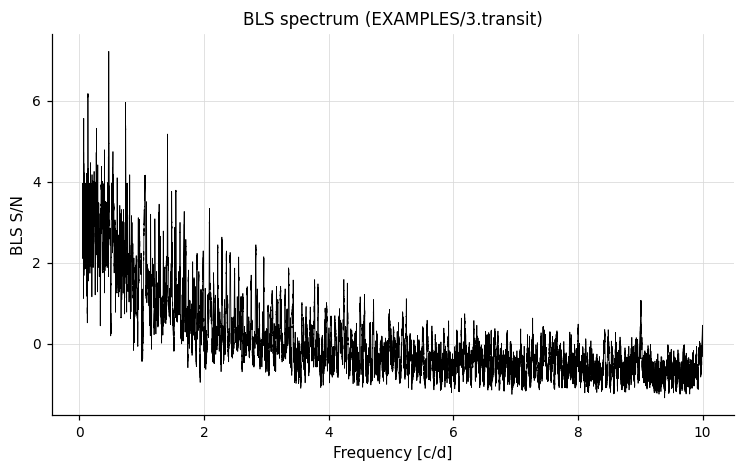
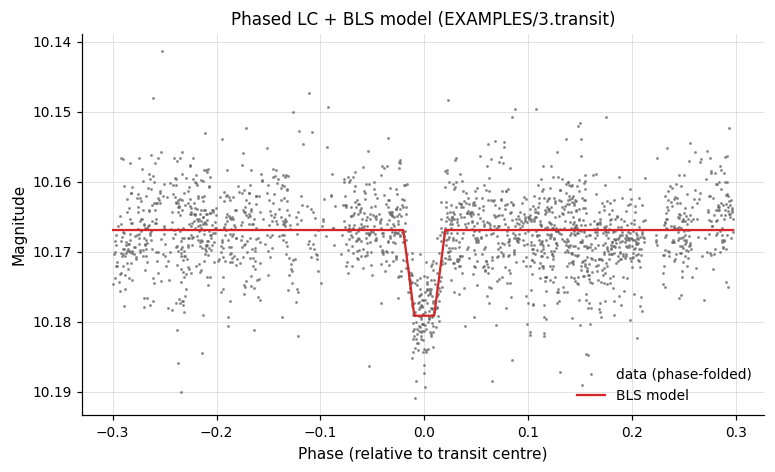
The output *.bls.model file contains the phased data and the best-fit trapezoidal model:
BLSFixPer — BLS at a Fixed Period
Syntax
cmd.BLSFixPer(period, rmin=0.01, rmax=0.1, nbins=200, timezone=0,
              qmin=None, qmax=None,
              save_model=False, correct_lc=False, fittrap=False,
              maskpoints=None)
Description
Run BLS at a single fixed period, searching only for the transit phase, depth, and duration. Useful as a second pass after a full BLS or LS period search.
CLI equivalent: -BLSFixPer.
Parameters
| Parameter | Type | Description |
|---|---|---|
period |
float or str |
Fixed period (days). Accepts back-reference keywords — see the tip below. |
rmin, rmax |
float or str |
r-mode duration bounds. |
qmin, qmax |
float or None |
q-mode duration bounds (ingress-to-egress fraction). When set, emits "q" qmin qmax instead of "r" rmin rmax. |
nbins |
int or str |
Number of phase bins. |
timezone |
float |
Time-zone offset (0 for HJD/BJD). |
save_model |
bool, str, or Output |
Best-fit transit model. True captures as result.files["BLSFixPer_model_N"]. |
correct_lc |
bool |
Subtract the best-fit transit from the LC before passing to the next command. |
fittrap |
bool |
Fit a trapezoidal transit instead of a box. |
maskpoints |
str or None |
Mask variable; points with maskvar ≤ 0 are excluded. |
Back-references for period
period accepts "ls", "aov", and "fixcolumn NAME" in addition to numeric values. The keyword resolves to the best period from the most recent matching prior command and works equally inside a single Pipeline or across chain steps (e.g. lc.LS(...).BLSFixPer(period="ls")). With no matching prior command in the chain, a LookupError is raised.
Output
Suffix N is the pipeline command index:
| Column | Description |
|---|---|
BLSFixPer_Period_N |
Period used. |
BLSFixPer_Tc_N |
Mid-transit epoch. |
BLSFixPer_SR_N |
BLS spectral residual. |
BLSFixPer_Depth_N |
Transit depth (mag). |
BLSFixPer_Qtran_N |
Fractional transit duration. |
BLSFixPer_Qingress_N, BLSFixPer_OOTmag_N |
Ingress fraction and out-of-transit magnitude. Only when fittrap=True. |
BLSFixPer_i1_N, BLSFixPer_i2_N |
Phases of transit ingress and egress. |
BLSFixPer_deltaChi2_N |
Δχ² of the transit. |
BLSFixPer_fraconenight_N |
Fraction of Δχ² from one night. |
BLSFixPer_Npointsintransit_N |
Points within the transit window. |
BLSFixPer_Ntransits_N |
Number of observed transits. |
BLSFixPer_Npointsbeforetransit_N, BLSFixPer_Npointsaftertransit_N |
Points immediately before/after each transit. |
BLSFixPer_Rednoise_N, BLSFixPer_Whitenoise_N |
Noise estimates. |
BLSFixPer_SignaltoPinknoise_N |
Signal-to-pink-noise. |
BLSFixPer_deltaChi2_invtransit_N |
Δχ² of the largest inverted (anti-transit) peak. |
BLSFixPer_MeanMag_N |
Out-of-transit mean magnitude. |
When save_model is enabled:
| File key | Description |
|---|---|
result.files["BLSFixPer_model_N"] |
DataFrame: phased data with the best-fit transit model. |
References
Kovács, Zucker & Mazeh 2002, A&A, 391, 369.
Examples
lc = vt.LightCurve.from_file("EXAMPLES/3.transit")

# Compute RMS, fit transit at fixed period, then check RMS on residuals
result = (
    lc.rms()
      .BLSFixPer("fix 2.12345", rmin=0.01, rmax=0.1, nbins=200, fittrap=True)
      .rms()
)
print(result.vars["BLSFixPer_Period_1"])    # 2.12345
print(result.vars["BLSFixPer_Depth_1"])     # transit depth
print(result.vars["BLSFixPer_Qtran_1"])     # fractional duration
BLSFixDurTc — BLS with Fixed Transit Duration and Epoch
Syntax
cmd.BLSFixDurTc(duration, Tc,
                minper=0.1, maxper=100.0, nfreq=10000,
                timezone=0, npeaks=1,
                fixdepth=None, qgress=None,
                save_periodogram=False, save_model=False,
                correct_lc=False, fittrap=False,
                save_phcurve=False, ophcurve_phmin=0.0,
                ophcurve_phmax=1.0, ophcurve_phstep=0.005,
                save_jdcurve=False, ojdcurve_jdstep=0.02,
                mergepeakdf=None, mergepeakdf_transit=None,
                maskpoints=None)
Description
Run BLS with the transit duration and reference epoch fixed; the period is searched over a grid from minper to maxper. Optionally the transit depth and ingress fraction (qgress) can also be fixed. For qgress: 0 = box-shaped, 0.5 = V-shaped (grazing).
duration and Tc each accept either a float (→ fix <value>), "fixcolumn <colname>", or "list" / "list column <N>".
CLI equivalent: -BLSFixDurTc.
Parameters
| Parameter | Type | Description |
|---|---|---|
duration |
float or str |
Transit duration (days). |
Tc |
float or str |
Mid-transit epoch (JD/BJD). |
minper, maxper |
float or str |
Period search range (days). |
nfreq |
int or str |
Number of trial frequencies. |
timezone |
float |
Time-zone offset (0 for UTC/BJD). |
npeaks |
int |
Number of peaks to report. |
fixdepth |
float, str, or None |
Fix transit depth to this value (or column/list spec); None to optimise. |
qgress |
float, str, or None |
Fractional ingress/egress duration (requires fixdepth). |
save_periodogram, save_model, save_phcurve, save_jdcurve |
bool, str, or Output |
Auxiliary file outputs (BLS spectrum, model, phase curve, JD curve). |
ophcurve_phmin, ophcurve_phmax, ophcurve_phstep |
float |
Phase range and step for the phase-curve output. Defaults 0.0, 1.0, 0.005. |
ojdcurve_jdstep |
float |
Time step (days) for the JD-curve output. Default 0.02. |
correct_lc |
bool |
Subtract the best-fit transit from the LC before passing to the next command. |
fittrap |
bool |
Fit a trapezoidal transit instead of a box. |
mergepeakdf, mergepeakdf_transit |
float or None |
Control the peak-merge frequency resolution Df, exactly as for BLS: mergepeakdf sets Df = factor/T (default Df = 1/T); mergepeakdf_transit sets Df = mult·q/T. Mutually exclusive. |
maskpoints |
str or None |
Mask variable; points with maskvar ≤ 0 are excluded. |
Output
Suffix N is the pipeline command index. Per-peak quantities use suffix k_N (1 to npeaks).
| Column | Description |
|---|---|
BLSFixDurTc_Duration_N |
Fixed transit duration used. |
BLSFixDurTc_Tc_N |
Fixed epoch used. |
BLSFixDurTc_Depth_N |
Fixed depth used. Only when fixdepth is set. |
BLSFixDurTc_Qingress_N |
Fixed ingress fraction used. Only when fixdepth is set. |
BLSFixDurTc_Period_k_N |
Best-fit period of peak k. |
BLSFixDurTc_SN_k_N |
Signal-to-noise of peak k. |
BLSFixDurTc_SR_k_N |
BLS spectral residual. |
BLSFixDurTc_SDE_k_N |
Signal detection efficiency. |
BLSFixDurTc_Depth_k_N |
Best-fit transit depth. |
BLSFixDurTc_Qtran_k_N |
Fractional transit duration. |
BLSFixDurTc_Qingress_k_N, BLSFixDurTc_OOTmag_k_N |
Ingress fraction and out-of-transit magnitude. Only when fittrap=True and fixdepth is not set. |
BLSFixDurTc_deltaChi2_k_N |
Δχ² of the best transit. |
BLSFixDurTc_fraconenight_k_N |
Fraction of Δχ² from one night. |
BLSFixDurTc_Npointsintransit_k_N |
Points within the transit window. |
BLSFixDurTc_Ntransits_k_N |
Number of observed transits. |
BLSFixDurTc_Npointsbeforetransit_k_N, BLSFixDurTc_Npointsaftertransit_k_N |
Points immediately before/after each transit. |
BLSFixDurTc_Rednoise_k_N, BLSFixDurTc_Whitenoise_k_N |
Noise estimates. |
BLSFixDurTc_SignaltoPinknoise_k_N |
Signal-to-pink-noise. |
BLSFixDurTc_Period_invtransit_N |
Period of the largest inverted (anti-transit) Δχ² peak. |
BLSFixDurTc_deltaChi2_invtransit_N |
Δχ² of the inverse-transit peak. |
BLSFixDurTc_MeanMag_N |
Out-of-transit mean magnitude. |
When save_* keywords are set:
| File key | Description |
|---|---|
result.files["BLSFixDurTc_periodogram_N"] |
BLS spectrum (frequency vs. SR). |
result.files["BLSFixDurTc_model_N"] |
Phased data with the best-fit transit model. |
result.files["BLSFixDurTc_phcurve_N"] |
Model phase curve. |
result.files["BLSFixDurTc_jdcurve_N"] |
Model curve in JD space. |
References
Kovács, Zucker & Mazeh 2002, A&A, 391, 369.
Examples
# Run a BLS search on EXAMPLES/3.transit with the transit duration
# and epoch held fixed.  The two `rms` calls show the residual scatter
# before and after subtracting the best-fit transit model.
lc = vt.LightCurve.from_file("EXAMPLES/3.transit")
pipe = (vt.Pipeline()
        .rms()
        .BLSFixDurTc(duration=0.076996297, Tc=53727.29676321477,
                     minper=0.1, maxper=20.0, nfreq=100000,
                     timezone=0, npeaks=1,
                     correct_lc=True, fittrap=True)
        .rms())
result = pipe.run(lc)
BLSFixPerDurTc — BLS with Fixed Period, Duration, and Epoch
Syntax
cmd.BLSFixPerDurTc(period, duration, Tc,
                   timezone=0,
                   fixdepth=None, qgress=None,
                   save_model=False, correct_lc=False, fittrap=False,
                   save_phcurve=False, ophcurve_phmin=0.0,
                   ophcurve_phmax=1.0, ophcurve_phstep=0.005,
                   save_jdcurve=False, ojdcurve_jdstep=0.02,
                   maskpoints=None)
Description
Compute BLS transit statistics for a fully specified signal — no period search is performed. The period, duration, and Tc are all fixed; the depth is optimised by default (or also fixed when fixdepth is given).
period, duration, and Tc each accept a float, "fixcolumn <colname>", or "list" / "list column <N>" (same forms as BLSFixDurTc).
CLI equivalent: -BLSFixPerDurTc.
Parameters
| Parameter | Type | Description |
|---|---|---|
period |
float or str |
Transit period (days). |
duration |
float or str |
Transit duration (days). |
Tc |
float or str |
Mid-transit epoch (JD/BJD). |
timezone |
float |
Time-zone offset (0 for UTC/BJD). |
fixdepth |
float, str, or None |
Fix transit depth (or column/list spec); None to optimise. |
qgress |
float, str, or None |
Fractional ingress/egress duration (requires fixdepth). |
save_model, save_phcurve, save_jdcurve |
bool, str, or Output |
Auxiliary file outputs. |
ophcurve_phmin, ophcurve_phmax, ophcurve_phstep |
float |
Phase range and step for the phase-curve output. Defaults 0.0, 1.0, 0.005. |
ojdcurve_jdstep |
float |
Time step (days) for the JD-curve output. Default 0.02. |
correct_lc |
bool |
Subtract the best-fit transit from the LC before passing to the next command. |
fittrap |
bool |
Fit a trapezoidal transit instead of a box. |
maskpoints |
str or None |
Mask variable; points with maskvar ≤ 0 are excluded. |
Output
Suffix N is the pipeline command index:
| Column | Description |
|---|---|
BLSFixPerDurTc_Period_N |
Period used. |
BLSFixPerDurTc_Duration_N |
Duration used. |
BLSFixPerDurTc_Tc_N |
Epoch used. |
BLSFixPerDurTc_Depth_N |
Transit depth (fixed input when fixdepth is set, otherwise best-fit). |
BLSFixPerDurTc_Qtran_N |
Fractional transit duration. |
BLSFixPerDurTc_Qingress_N, BLSFixPerDurTc_OOTmag_N |
Ingress fraction and out-of-transit magnitude. Only when fittrap=True and fixdepth is not set. When fixdepth is set, only BLSFixPerDurTc_Qingress_N (the fixed input value) is emitted. |
BLSFixPerDurTc_deltaChi2_N |
Δχ² of the transit signal. |
BLSFixPerDurTc_fraconenight_N |
Fraction of Δχ² from one night. |
BLSFixPerDurTc_Npointsintransit_N |
Points within the transit window. |
BLSFixPerDurTc_Ntransits_N |
Number of observed transits. |
BLSFixPerDurTc_Npointsbeforetransit_N, BLSFixPerDurTc_Npointsaftertransit_N |
Points immediately before/after each transit. |
BLSFixPerDurTc_Rednoise_N, BLSFixPerDurTc_Whitenoise_N |
Noise estimates. |
BLSFixPerDurTc_SignaltoPinknoise_N |
Signal-to-pink-noise. |
BLSFixPerDurTc_MeanMag_N |
Out-of-transit mean magnitude. |
When save_* keywords are set:
| File key | Description |
|---|---|
result.files["BLSFixPerDurTc_model_N"] |
Phased data with the best-fit transit model. |
result.files["BLSFixPerDurTc_phcurve_N"] |
Model phase curve. |
result.files["BLSFixPerDurTc_jdcurve_N"] |
Model curve in JD space. |
References
Kovács, Zucker & Mazeh 2002, A&A, 391, 369.
Examples
# Evaluate BLS statistics on EXAMPLES/3.transit with period, duration,
# and Tc all fixed; subtract the best-fit transit model.
lc = vt.LightCurve.from_file("EXAMPLES/3.transit")
pipe = (vt.Pipeline()
        .rms()
        .BLSFixPerDurTc(period=2.12345,
                        duration=0.076996297,
                        Tc=53727.29676321477,
                        timezone=0,
                        correct_lc=True, fittrap=True)
        .rms())
result = pipe.run(lc)
dftclean — DFT Power Spectrum + CLEAN
Syntax
cmd.dftclean(nbeam, maxfreq=None, save_dspec=False, save_wfunc=False,
             save_cspec=False, gain=0.1, SNlimit=3.0, npeaks=None,
             finddirtypeaks=None, finddirtypeaks_clip=None,
             finddirtypeaks_clipiter=None,
             outcbeam=False, useampspec=False, verboseout=False,
             maskpoints=None)
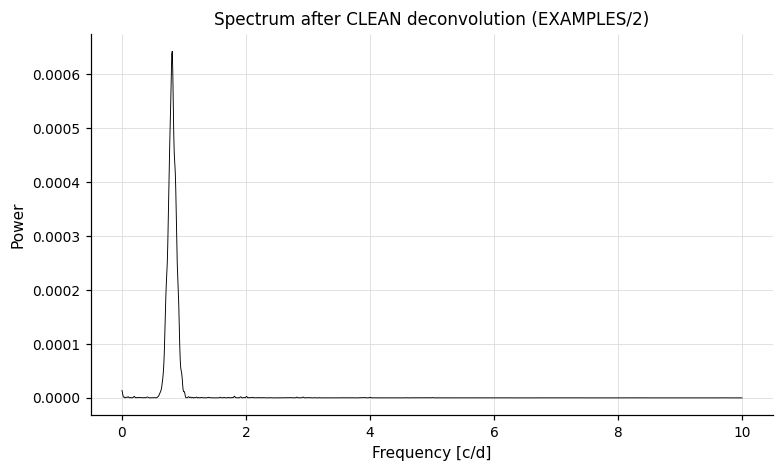
Description
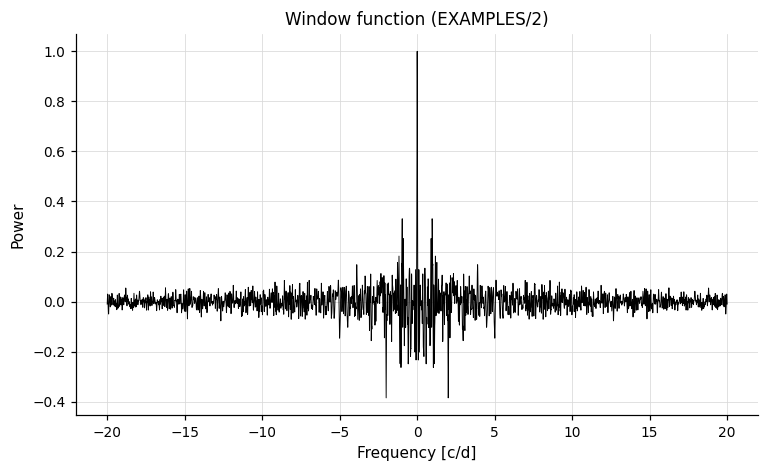
Compute the Discrete Fourier Transform (DFT) power spectrum of the light curve using the FDFT algorithm of Kurtz (1985), and optionally deconvolve it with the CLEAN algorithm of Roberts, Lehar & Dreher (1987) to remove aliasing due to the window function.
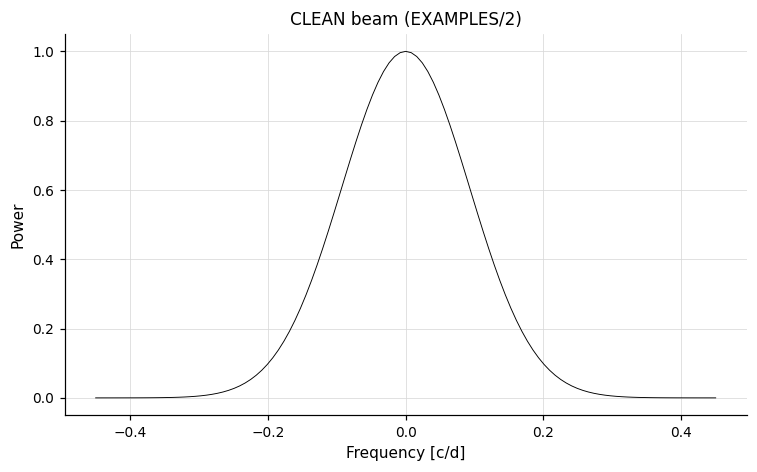
The CLEAN iteration starts from the dirty spectrum, identifies the strongest peak, subtracts a scaled CLEAN beam centred on that peak, and repeats until the residual is below SNlimit · noise. The gain parameter (∈ [0.1, 1.0]) controls how aggressively each iteration removes the peak: smaller is slower but more thorough.
CLI equivalent: -dftclean.
Parameters
| Parameter | Type | Description |
|---|---|---|
nbeam |
int or str |
Number of frequency samples per 1/T element (T = light-curve baseline). Controls spectral resolution. |
maxfreq |
float, str, or None |
Maximum frequency (cycles/day). Default: 1 / (2 · min_time_separation) (Nyquist). |
save_dspec, save_cspec, save_wfunc |
bool, str, or Output |
Save the dirty spectrum, CLEAN spectrum, and window function. Captured as result.files["dftclean_dspec_N"], result.files["dftclean_cspec_N"], result.files["dftclean_wfunc_N"]. |
gain, SNlimit |
float |
CLEAN gain (∈ [0.1, 1.0]) and SN-stop threshold. CLEAN runs only when at least one of save_cspec / npeaks / finddirtypeaks is set. |
npeaks |
int or None |
Number of peaks to find in the clean spectrum. |
finddirtypeaks |
int or None |
Number of peaks to find in the dirty spectrum. |
finddirtypeaks_clip, finddirtypeaks_clipiter |
float, int |
Sigma-clipping for dirty-peak SNR (default: iterative 5σ). |
outcbeam |
bool, str, or Output |
Write the CLEAN beam to a file. True captures as result.files["dftclean_cbeam_N"]. |
useampspec |
bool |
Compute SNR on the amplitude spectrum instead of the power spectrum. |
verboseout |
bool |
Include the mean and stddev of the spectrum (before and after clipping) in the output. |
maskpoints |
str or None |
Mask variable; points with maskvar ≤ 0 are excluded. |
Output
Peak indices in dftclean output columns are 0-indexed (k runs from 0 to npeaks − 1 or finddirtypeaks − 1). N is the pipeline command index:
| Column | Description |
|---|---|
DFTCLEAN_DSPEC_PEAK_FREQ_k_N |
Frequency of dirty-spectrum peak k (cycles/day). Only when finddirtypeaks is set. |
DFTCLEAN_DSPEC_PEAK_POW_k_N |
Power at the dirty peak. Only when finddirtypeaks is set. |
DFTCLEAN_DSPEC_PEAK_SNR_k_N |
SNR of the dirty peak. Only when finddirtypeaks is set. |
DFTCLEAN_CSPEC_PEAK_FREQ_k_N, _POW_k_N, _SNR_k_N |
Same trio for the CLEAN-spectrum peaks. Only when npeaks is set. |
DFTCLEAN_DSPEC_AVESPEC_N, DFTCLEAN_DSPEC_STDSPEC_N |
Mean / RMS of the (sigma-clipped) dirty power spectrum. Only when verboseout=True and finddirtypeaks is set. |
DFTCLEAN_DSPEC_AVESPEC_NOCLIP_N, DFTCLEAN_DSPEC_STDSPEC_NOCLIP_N |
Same statistics computed without sigma-clipping. Same condition. |
DFTCLEAN_CSPEC_AVESPEC_N, DFTCLEAN_CSPEC_STDSPEC_N |
Mean / RMS of the (sigma-clipped) CLEAN spectrum. Only when verboseout=True and npeaks is set. |
DFTCLEAN_CSPEC_AVESPEC_NOCLIP_N, DFTCLEAN_CSPEC_STDSPEC_NOCLIP_N |
Same statistics without sigma-clipping. Same condition. |
When save_* keywords are set:
| File key | Description |
|---|---|
result.files["dftclean_dspec_N"] |
DataFrame: dirty power spectrum (frequency vs. power). |
result.files["dftclean_cspec_N"] |
DataFrame: CLEAN power spectrum. |
result.files["dftclean_wfunc_N"] |
DataFrame: window function. |
result.files["dftclean_cbeam_N"] |
DataFrame: CLEAN beam (when outcbeam=True). |
References
Kurtz 1985, MNRAS, 213, 773 for the FDFT algorithm. Roberts, Lehar & Dreher 1987, AJ, 93, 968 for the CLEAN algorithm.
Examples
lc = vt.LightCurve.from_file("EXAMPLES/2")

# Compute DFT CLEAN periodogram and find the top peak
result = lc.dftclean(4, maxfreq=10.0, npeaks=1, save_dspec=True)
print(result.vars["DFTCLEAN_CSPEC_PEAK_FREQ_0_0"])  # top CLEAN-spectrum peak frequency (cycles/day)
dspec = result.files["dftclean_dspec_0"]   # pd.DataFrame: dirty spectrum (frequency vs power)
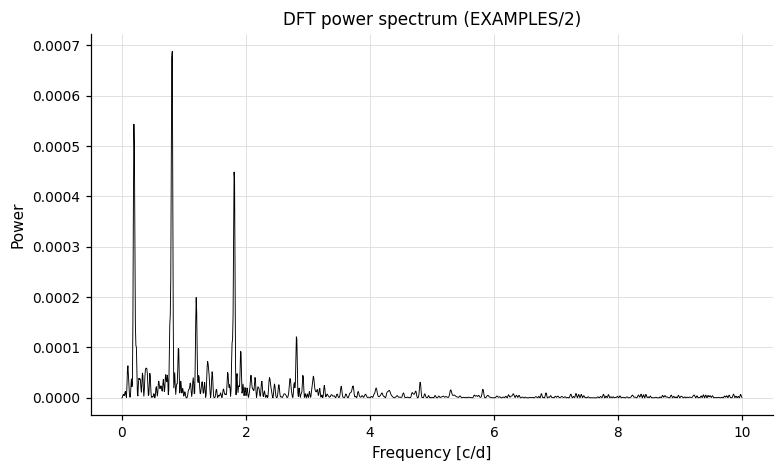
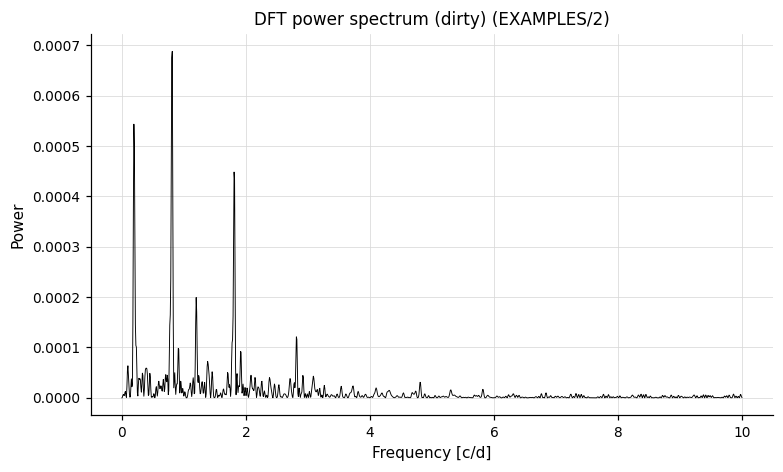
A second example injects three harmonics, runs CLEAN, and writes the four output products (dirty spectrum, cleaned spectrum, CLEAN beam, window function):
wwz — Weighted Wavelet Z-Transform
Syntax
cmd.wwz(maxfreq="auto", freqsamp=None, tau0="auto", tau1="auto",
        dtau="auto", c=0.0125, save_transform=False,
        save_maxtransform=False,
        transform_format=None, transform_name=None,
        maxtransform_name=None, maskpoints=None)
Description
Compute the Weighted Wavelet Z-Transform (WWZ) as defined by Foster (1996), using an abbreviated Morlet wavelet:
The transform is computed for all combinations of trial frequency (up to maxfreq) and time shift (tau0 to tau1 in steps of dtau). The result is a time-frequency map of signal power, especially useful for non-stationary signals. The decay constant c controls the trade-off between time and frequency resolution.
CLI equivalent: -wwz.
Parameters
| Parameter | Type | Description |
|---|---|---|
maxfreq |
float, str, or "auto" |
Maximum frequency in cycles/day. "auto" = 1 / (2 · min_time_separation). |
freqsamp |
float, str, or None |
Frequency sampling as a multiple of 1/T. |
tau0, tau1 |
float, str, or "auto" |
Start and end times for the time-shift scan. "auto" uses min/max of the LC time. |
dtau |
float, str, or "auto" |
Step size in time shift. "auto" = minimum time separation. |
c |
float or str |
Morlet wavelet decay constant (default: 1/(8π²) ≈ 0.0125). |
save_transform |
bool, str, or Output |
Write the full 2-D transform; captured as result.files["wwz_transform_N"]. |
save_maxtransform |
bool, str, or Output |
Write the max-Z projection over frequency; captured as result.files["wwz_maxtransform_N"]. |
transform_format |
str or None |
Output format for the full transform: "fits" or "pm3d". Only used when save_transform is set. |
transform_name, maxtransform_name |
str or None |
Naming format strings for the output files (e.g. "%s.wwz"). |
maskpoints |
str or None |
Mask variable; points with maskvar ≤ 0 are excluded. |
Output
Suffix N is the pipeline command index:
| Column | Description |
|---|---|
MaxWWZ_N |
Maximum value of the Z-transform over all time-shifts and frequencies. |
MaxWWZ_Freq_N |
Frequency at the maximum Z. |
MaxWWZ_TShift_N |
Time-shift τ at the maximum Z. |
MaxWWZ_Power_N |
Power at the maximum Z. |
MaxWWZ_Amplitude_N |
Amplitude at the maximum Z. |
MaxWWZ_Neffective_N |
Effective number of data points at the maximum Z. |
MaxWWZ_AverageMag_N |
Local mean magnitude at the maximum Z. |
Med_WWZ_N |
Median Z over τ at the max-Z frequency. |
Med_Freq_N |
Median frequency over τ. |
Med_Power_N |
Median power over τ. |
Med_Amplitude_N |
Median amplitude over τ. |
Med_Neffective_N |
Median Neffective over τ. |
Med_AverageMag_N |
Median local mean magnitude over τ. |
When save_* keywords are set:
| File key | Description |
|---|---|
result.files["wwz_transform_N"] |
Full time-frequency map of the transform. |
result.files["wwz_maxtransform_N"] |
DataFrame: time vs. peak-frequency power. |
References
Foster 1996, AJ, 112, 1709.
Examples
lc = vt.LightCurve.from_file("EXAMPLES/8")

# tau0 / tau1 set the time range scanned by the wavelet; derive them
# from the observed time baseline of the light curve.
result = lc.wwz(maxfreq=2.0, freqsamp=0.25,
                tau0=float(lc.t.min()), tau1=float(lc.t.max()),
                dtau=0.1, save_transform=True, save_maxtransform=True)
maxt = result.files["wwz_maxtransform_0"]   # pd.DataFrame: time vs peak frequency/power
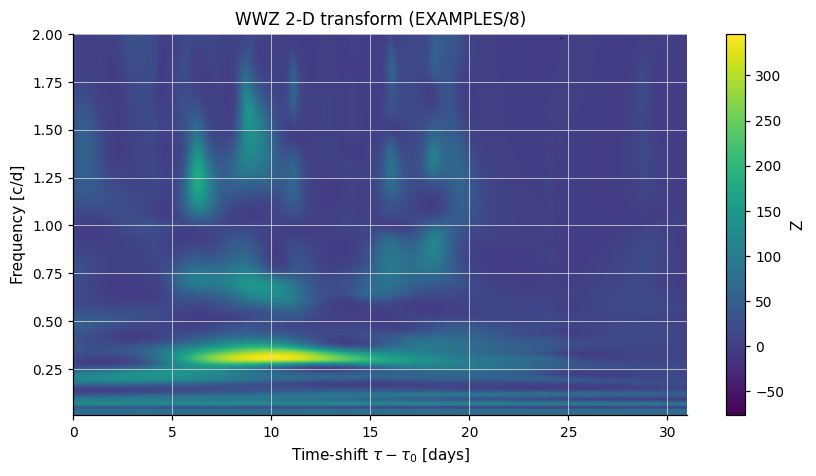
The transient ~0.3 cyc/day signal is visible only between days 5–20 of the series.
GetLSAmpThresh — Minimum Detectable Amplitude
Syntax
cmd.GetLSAmpThresh(period="ls", minp=0.1, thresh=10.0,
                   mode="harm", nharm=1, nsubharm=0,
                   listfile=None, noGLS=False)
Description
Determine the minimum peak-to-peak amplitude that a signal at a given period must have to be detected by a Lomb-Scargle search with −ln(FAP) > thresh. The signal shape is either a Fourier series (mode="harm") or read from a file (mode="file"). The threshold is computed by scaling the signal template until the LS statistic reaches the detection limit.
Used primarily in injection-recovery studies — typically chained after a Lomb-Scargle search and a harmonic fit (see the example below).
CLI equivalent: -GetLSAmpThresh.
Parameters
| Parameter | Type | Description |
|---|---|---|
period |
float or str |
Reference period. Accepts the "ls" back-reference keyword (use the period from the most recent -LS). See the tip below. |
minp |
float |
Minimum period that would be searched (sets the FAP scale). |
thresh |
float |
Desired −ln(FAP) detection threshold. |
mode |
str |
Signal model: "harm" (Fourier series, default) or "file" (read template from listfile). |
nharm |
int |
Number of harmonics (only when mode="harm"). |
nsubharm |
int |
Number of sub-harmonics (only when mode="harm"). |
listfile |
str or None |
Path to template-signal list file (required when mode="file"). |
noGLS |
bool |
Use classical Lomb-Scargle instead of the generalised (GLS) form. |
Back-reference for period
period accepts the "ls" keyword to inherit the best period from the most recent prior LS. Unlike most back-references, this one is only meaningful in single-Pipeline usage and cannot take a bare number — only "ls" or "list" is accepted in this slot. Across a chain boundary the lookup is not supported; pyvartools raises NotImplementedError when no prior LS is present in the chain. In that case, use a single Pipeline invocation that includes the LS step.
Output
Suffix N is the pipeline command index:
| Column | Description |
|---|---|
LS_AmplitudeScaleFactor_N |
Scale factor applied to the template signal at the detection threshold. |
LS_MinimumAmplitude_N |
Resulting minimum peak-to-peak amplitude (mag). |
References
Same references as LS (Zechmeister & Kürster 2009; Press et al. 1992; Lomb 1976; Scargle 1982; Press & Rybicki 1989).
Examples
lc = vt.LightCurve.from_file("EXAMPLES/2")

# Run LS, fit harmonic (fitonly), then compute minimum detectable amplitude
pipe = (vt.Pipeline()
        .LS(0.1, 10.0, 0.1, npeaks=1)
        .harmonicfilter("ls", nharm=0, nsubharm=0, fitonly=True)
        .GetLSAmpThresh("ls", minp=0.1, thresh=-100.0, nharm=0, nsubharm=0))
result = pipe.run(lc)
print(result.vars["LS_Period_1_0"])           # 1.23440877
print(result.vars["LS_MinimumAmplitude_2"])   # 0.00248 mag
Shared topics
fixperiod_snr — fixed-period significance
Several period-finding commands (LS, aov, aov_harm) accept a fixperiod_snr keyword that evaluates the periodogram at a single known period and reports its significance, in addition to the regular peak search.
When set, extra output columns are appended (N = 0-based pipeline index of the command). The exact column names differ across the three commands:
For LS:
| Column | Description |
|---|---|
LS_PeriodFix_N |
The fixed period used. |
Log10_LS_Prob_PeriodFix_N |
Log₁₀ false-alarm probability at that period. |
LS_Periodogram_Value_PeriodFix_N |
Periodogram statistic at that period. |
LS_SNR_PeriodFix_N |
SNR = (power − ⟨power⟩) / σ. |
For aov (with default uselog=False):
| Column | Description |
|---|---|
PeriodFix_N |
The fixed period used. |
AOV_PeriodFix_N |
θ_aov statistic at that period. |
AOV_SNR_PeriodFix_N |
SNR at that period. |
AOV_NEG_LN_FAP_PeriodFix_N |
−ln(FAP) at that period. |
When uselog=True, only PeriodFix_N and AOV_LOGSNR_PeriodFix_N are emitted.
For aov_harm:
| Column | Description |
|---|---|
PeriodFix_N |
The fixed period used. |
AOV_HARM_PeriodFix_N |
Multi-harmonic AoV statistic at that period. |
AOV_HARM_SNR_PeriodFix_N |
SNR at that period. |
AOV_HARM_NEG_LN_FAP_PeriodFix_N |
−ln(FAP) at that period. Only when nharm > 0. |
Accepted Python values:
| Python value | When to use |
|---|---|
1.234 (number) |
Period known at pipeline-construction time. |
"ls" |
Use the best period found by the most recent prior LS run. |
"aov" |
Use the best period found by the most recent prior aov (or aov_harm) run. |
"injectharm" |
Use the injected-signal period from a prior injection run. |
"fixcolumn LS_Period_1_0" |
Read the period from a named per-LC variable. |
"list" |
Read the period from a list-file column (list-mode runs only). |
"list column 2" |
Read the period from column 2 of the list file. |
Back-references work across chain steps
fixperiod_snr accepts "ls", "aov", "injectharm", and "fixcolumn NAME" in both single-Pipeline usage and across chain boundaries (e.g. lc.LS(...).LS(fixperiod_snr="ls")). Across a chain boundary, pyvartools substitutes the concrete numeric value pulled from the prior Result. The "aov" keyword picks the most recent prior aov or aov_harm, whichever ran later. "fixcolumn NAME" requires a column name (not a numeric column index) when used across a chain boundary. A missing prior command raises LookupError.
Variable and expression parameters
Most numeric parameters throughout pyvartools accept variable names and expressions in addition to fixed numeric values. This includes parameters on the period-finding commands above as well as clip, fluxtomag, difffluxtomag, medianfilter, harmonicfilter, linfit, Injectharm, Injecttransit, MandelAgolTransit, Starspot, nonlinfit, BLSFixDurTc, BLSFixPerDurTc, autocorrelation, dftclean, wwz, binlc, addnoise, microlens, and Phase.
As an example, minp, maxp, and subsample on LS each accept four forms:
| Value | When to use |
|---|---|
A number (float or int) |
Fixed value known at pipeline-construction time. |
A bare identifier string, e.g. "minperiod" |
Value is read from a named per-LC variable — typically one supplied via perlc_vars on the run method, or by an earlier command in the chain. |
Any other string, e.g. "tspan/200" |
Evaluated as a math expression per light curve. |
A numpy array, PerLC, or pd.Series |
A different value for each light curve in a batch run. See Per-LC array parameters. |
The identifier rule is: if the string matches [A-Za-z_]\w* it is treated as a variable name; otherwise it is treated as an expression.
Defining variables for the expr form
The expr keyword evaluates an expression against vartools' internal variable registry at the time each light curve is processed. Variables such as tspan are not built-in; they must be defined by prior commands in the same pipeline. Use cmd.stats to compute per-star statistics and cmd.expr to derive new variables from them:
cmd.stats("t", "min,max")                         # → STATS_t_MIN_0, STATS_t_MAX_0
cmd.expr("tspan=STATS_t_MAX_0-STATS_t_MIN_0")     # → tspan
The var form similarly requires the named variable to exist in the per-star variable registry. This is most naturally supplied via run_filelist with a list file that includes per-star columns for minp and maxp.