Model Fitting
Parametric models fit to a light curve: transits, starspots, microlensing, generic linear / non-linear fits.
linfit — Linear combination fitting
Syntax
cmd.linfit(function, paramlist,
           modelvar=None,
           reject=None, reject_usemad=False, reject_iter=False,
           reject_fixednum=None,
           correct_lc=False, save_model=False,
           model_nameformat=None, fitmask=None)
Description
Fit a function that is linear in its free parameters to each light curve using least squares. function is a vartools expression string (e.g. 'a1*t^2+a2*t+a3'); paramlist is a comma-separated list of free parameter names (e.g. 'a1,a2,a3'). Parameter names must not conflict with built-in vector variables (t, mag, err, …). Optional sigma-clipping rejection and refit is available, the best-fit model can be subtracted from the LC (correct_lc=True), and the model can be written to disk via save_model.
CLI equivalent: -linfit.
Parameters
| Parameter | Type | Description |
|---|---|---|
function |
str |
Analytic function to fit (e.g. 'a*(t-t0)^2+b*(t-t0)+c'). |
paramlist |
str |
Comma-separated list of free parameter names (e.g. 'a,b,c'). |
modelvar |
str or None |
Variable name used to store the best-fit model values on the light curve (vector variable for use by later commands). |
reject |
float or None |
Sigma-clipping threshold: fit, clip outliers beyond this threshold (in σ), then refit. |
reject_usemad |
bool |
Use MAD instead of standard deviation for the scatter estimate during rejection. |
reject_iter |
bool |
Iteratively reject and refit until no more points are clipped. |
reject_fixednum |
int or None |
Maximum number of rejection/refit iterations (requires reject_iter=True). |
correct_lc |
bool |
Subtract the best-fit model from the light curve before passing to the next command. |
save_model |
bool, str, or Output |
Auxiliary file output. True captures as result.files["linfit_model_N"]; a path string writes to that directory without capturing; Output(path, capture=True) does both. See Auxiliary output files. |
model_nameformat |
str or None |
Format string for the model output filename (e.g. "%s.linfit.model"). |
fitmask |
str or None |
Name of a mask variable; only points with maskvar > 0 are included in the fit. |
Output
Suffix N is the 0-indexed pipeline command position. For each free parameter <p> in paramlist:
| Column | Description |
|---|---|
Linfit_<p>_N |
Best-fit value of parameter <p>. |
Linfit_err<p>_N |
1-σ uncertainty in <p> (from the covariance matrix). |
When save_model is set:
| File key | Description |
|---|---|
result.files["linfit_model_N"] |
DataFrame: time-sampled best-fit model values for the light curve. |
Examples
lc = vt.LightCurve.from_file("EXAMPLES/1")

# Fit a quadratic polynomial, using minimum time as reference epoch
pipe = (vt.Pipeline()
        .stats("t", ["min"])
        .expr("t0=STATS_t_MIN_0")
        .linfit("a*(t-t0)^2+b*(t-t0)+c", "a,b,c"))
result = pipe.run(lc)
print(result.vars["Linfit_a_2"])   # quadratic coefficient
print(result.vars["Linfit_b_2"])   # linear coefficient
print(result.vars["Linfit_c_2"])   # constant offset
nonlinfit — Non-linear least-squares fitting
Syntax
cmd.nonlinfit(function, paramlist,
              optimizer="amoeba",
              linfit_params=None, errors=None,
              covariance=None, priors=None, constraints=None,
              amoeba_tolerance=None, amoeba_maxsteps=None,
              mcmc_naccept=None, mcmc_nlinkstotal=None,
              mcmc_fracburnin=None, mcmc_eps=None,
              mcmc_skipamoeba=False, mcmc_maxmemstore=None,
              mcmc_outchains=False, mcmc_chains_format=None,
              mcmc_chains_printevery=None,
              correct_lc=False, save_model=False,
              model_nameformat=None, modelvar=None,
              fitmask=None)
Description
Fit an arbitrary analytic function that is non-linear in its free parameters to each light curve. Two optimisers are supported: "amoeba" (downhill simplex / Nelder-Mead, fast greedy local minimisation) and "mcmc" (differential-evolution Markov chain Monte Carlo, full posterior exploration). Parameters that enter the model linearly may be moved out of the non-linear search and fit by linear least squares (linfit_params), which is faster and more numerically stable. Optional Gaussian-process covariance kernels (squareexp, exp, matern) handle correlated errors; arbitrary priors and constraints can be added.
paramlist has the form name=initial:step[:min:max], ... for "amoeba", or supplies initial values and proposal step sizes for "mcmc".
CLI equivalent: -nonlinfit.
Parameters
| Parameter | Type | Description |
|---|---|---|
function |
str |
Analytic function to fit (e.g. 'a+b*exp(-(t-c)^2/(2*d^2))'). |
paramlist |
str |
Comma-separated parameters with initial guesses and step sizes (e.g. 'c=5.0:2.0,d=10.0:8.0'). |
optimizer |
str |
"amoeba" (Nelder-Mead, default) or "mcmc" (differential-evolution MCMC). |
linfit_params |
str or None |
Comma- or space-separated names of parameters that enter linearly; solved analytically at each step. Not included in MCMC posteriors. |
errors |
str or None |
Expression or variable name providing per-point measurement errors (overrides the default error column). |
covariance |
str or None |
Gaussian-process kernel tokens, e.g. "squareexp amp_v rho_v", "exp amp rho", "matern amp rho nu". Linear-only fitting is not permitted with covariance. |
priors |
str or None |
Comma-separated list of prior expressions, each evaluating to -2 ln P (e.g. '(t0-4.0)^2/3.0^2'). |
constraints |
str or None |
Comma-separated list of constraint expressions (e.g. 'sigma>0'). |
amoeba_tolerance |
float or None |
Δχ² convergence tolerance for the amoeba optimizer. |
amoeba_maxsteps |
int or None |
Maximum number of steps for the amoeba optimizer. |
mcmc_naccept |
int or None |
Number of accepted links to collect (mutually exclusive with mcmc_nlinkstotal). |
mcmc_nlinkstotal |
int or None |
Total number of MCMC links (accepted + rejected). |
mcmc_fracburnin |
float or None |
Fraction of links to discard as burn-in (default 0.1). |
mcmc_eps |
float or None |
Initial step size for the MCMC proposal distribution (default 0.001). |
mcmc_skipamoeba |
bool |
Skip the initial amoeba pre-optimisation in MCMC mode. |
mcmc_maxmemstore |
int or None |
Maximum number of chain links (or GB; default 4) to hold in memory simultaneously. |
mcmc_outchains |
bool, str, or Output |
Write MCMC chain files. True captures as result.files["nonlinfit_chains_N"]. |
mcmc_chains_format |
str or None |
Naming format string for chain output files. |
mcmc_chains_printevery |
int or None |
Write every Nth accepted link to the chain file. |
correct_lc |
bool |
Subtract the best-fit model from the light curve before passing to the next command. |
save_model |
bool, str, or Output |
Auxiliary file output. True captures as result.files["nonlinfit_model_N"]. See Auxiliary output files. |
model_nameformat |
str or None |
Format string for the model output filename. |
modelvar |
str or None |
Variable name used to store the best-fit model values on the light curve. |
fitmask |
str or None |
Name of a mask variable; only points with maskvar > 0 are included in the fit. |
Output
Suffix N is the 0-indexed pipeline command position. Columns differ between the two optimisers:
optimizer="amoeba":
| Column | Description |
|---|---|
Nonlinfit_<p>_BestFit_N |
Best-fit value of each non-linear parameter and (for linfit_params parameters) each linear coefficient. |
Nonlinfit_<p>_Err_N |
1-σ uncertainty in each parameter, derived from the covariance matrix at the optimum. |
Nonlinfit_BestFit_Chi2_N |
χ² of the best-fit model. |
Nonlinfit_HasConverged_N |
1 if the amoeba optimiser converged within amoeba_maxsteps, 0 otherwise. |
optimizer="mcmc":
| Column | Description |
|---|---|
Nonlinfit_<p>_BestFit_N |
Best-fit (lowest-χ²) value of each non-linear parameter sampled by the chain. |
Nonlinfit_<p>_MEDIAN_N |
Posterior median of each parameter. |
Nonlinfit_<p>_STDDEV_N |
Posterior standard deviation of each parameter. |
Nonlinfit_BestFit_Chi2_N |
χ² of the best-fit model. |
When save_model is set:
| File key | Description |
|---|---|
result.files["nonlinfit_model_N"] |
DataFrame: time-sampled best-fit model. |
result.files["nonlinfit_chains_N"] |
DataFrame: MCMC chain (when mcmc_outchains=True); one row per accepted link. |
Examples
Example 1. Inject a Gaussian into EXAMPLES/3 and fit it back. Two parameters (c, the peak time, and d, the width) are searched non-linearly with amoeba; the linear parameters (a, b) are obtained by linear least squares (linfit_params).
lc = vt.LightCurve.from_file("EXAMPLES/3")
pipe = (vt.Pipeline()
        .stats("t", "min,max")
        .expr("t1=STATS_t_MIN_0")
        .expr("Dt=(STATS_t_MAX_0-STATS_t_MIN_0)")
        .expr("mag=mag+0.1*exp(-0.5*((t-(t1+Dt*0.2))/(Dt*0.05))^2)")
        .nonlinfit("a+b*exp(-(t-c)^2/(2*d^2))",
                   "c=(t1+Dt*0.3):(0.1*Dt),d=(Dt*0.1):(0.1*Dt)",
                   optimizer="amoeba",
                   linfit_params="a,b",
                   save_model="EXAMPLES/OUTDIR1/"))
result = pipe.run(lc)
Example 2. Same model and injection as Example 1, but explore the χ² landscape with MCMC. All four parameters are now free non-linear parameters with their own initial guesses and step sizes.
lc = vt.LightCurve.from_file("EXAMPLES/3")
pipe = (vt.Pipeline()
        .stats("t", "min,max")
        .expr("t1=STATS_t_MIN_0")
        .expr("Dt=(STATS_t_MAX_0-STATS_t_MIN_0)")
        .expr("mag=mag+0.1*exp(-0.5*((t-(t1+Dt*0.2))/(Dt*0.05))^2)")
        .nonlinfit("a+b*exp(-(t-c)^2/(2*d^2))",
                   "a=10.167:0.0002,b=0.1:0.0008,"
                   "c=(t1+Dt*0.2):(0.005),d=(Dt*0.05):(0.016)",
                   optimizer="mcmc",
                   mcmc_nlinkstotal=10000,
                   mcmc_outchains="EXAMPLES/OUTDIR1/"))
result = pipe.run(lc)
decorr — Decorrelation
Syntax
cmd.decorr(correct_lc=True, zeropointterm=1, subtractfirstterm=0,
           global_files=None, lc_columns=None, save_model=False,
           maskpoints=None)
Description
Decorrelate the light curve against external trend vectors and/or light-curve-internal columns using polynomial regression. global_files is a list of (filename, polynomial_order) tuples for external trend files (each formatted JD signal_value); lc_columns is a list of (column_number, polynomial_order) tuples for light-curve-internal trends.
CLI equivalent: -decorr.
Deprecated
The underlying -decorr command is deprecated as of VARTOOLS 1.3. Use linfit instead.
Parameters
| Parameter | Type | Description |
|---|---|---|
correct_lc |
bool |
Apply the decorrelation to the light curve (True) or just compute and output coefficients without modifying it (False). |
zeropointterm |
int |
1 to include a zero-point offset term in the fit; 0 to omit it. |
subtractfirstterm |
int |
1 to decorrelate against (signal − signal[0]) rather than signal directly (useful for detrending against JD). |
global_files |
list of (str, int) or None |
List of (filename, polynomial_order) tuples for external trend files. |
lc_columns |
list of (int, int) or None |
List of (column_number, polynomial_order) tuples for light-curve-internal trends. |
save_model |
bool, str, or Output |
Directory for auxiliary file output. A string is the directory name (not a filename); per-LC *.decorr.model files are written inside it. True captures as result.files["decorr_model_N"]. See Auxiliary output files. |
maskpoints |
str or None |
Mask variable; only points with maskvar > 0 contribute to the fit. |
Output
Suffix N is the 0-indexed pipeline command position. The exact set of columns depends on the number of global_files and lc_columns terms and on zeropointterm; each polynomial coefficient is reported with its 1-σ error, plus an overall χ²:
| Column | Description |
|---|---|
Decorr_constant_term_N |
Zero-point offset (only when zeropointterm=1). |
Decorr_constant_term_err_N |
1-σ uncertainty in the zero-point offset. |
Global_<i>_coeff_<order>_N |
Best-fit coefficient for global trend file i (1-indexed) at polynomial order. |
Global_<i>_coeff_err_<order>_N |
1-σ uncertainty in the corresponding global-trend coefficient. |
LCColumn_<col>_coeff_<order>_N |
Best-fit coefficient for light-curve column col at polynomial order. |
LCColumn_<col>_coeff_err_<order>_N |
1-σ uncertainty in the corresponding LC-column coefficient. |
Decorr_chi2_N |
χ² of the decorrelation fit. |
When save_model is set:
| File key | Description |
|---|---|
result.files["decorr_model_N"] |
DataFrame: time-sampled best-fit decorrelation model. |
Examples
lcs = [vt.LightCurve.from_file(f"EXAMPLES/{i}") for i in range(1, 11)]

# Decorrelate against the time column using a quadratic polynomial
pipe = (vt.Pipeline()
        .rms()
        .decorr(correct_lc=True, zeropointterm=1, subtractfirstterm=1,
               lc_columns=[(1, 2)])
        .rms())
batch = pipe.run_batch(lcs)
print(batch.vars[["Name", "RMS_0", "RMS_2"]])
MandelAgolTransit — Mandel-Agol transit model
Syntax
cmd.MandelAgolTransit(P0, T00, r0=0.1, a0=10.0, inclination=90.0,
                      bimpact=None,
                      e0=0.0, omega0=0.0, mconst0=0.0,
                      ld_type="quad", ld_coeffs=None,
                      fitephem=1, fitr=1, fita=1,
                      fitinclterm=1, fite=0, fitomega=0,
                      fitmconst=1, fitldcoeffs=None,
                      rv_file=None, rv_model_file=None,
                      K0=None, gamma0=None, fitK=0, fitgamma=0,
                      correct_lc=False, save_model=False,
                      modelvar=None,
                      save_phcurve=False,
                      ophcurve_phmin=0.0, ophcurve_phmax=1.0,
                      ophcurve_phstep=0.005,
                      save_jdcurve=False, ojdcurve_jdstep=0.02)
Description
Fit a Mandel & Agol (2002) transit model to the light curve. Initial values for the period and transit centre can be entered directly or seeded from a preceding BLS / BLSFixPer run (P0="bls" or "blsfixper"). Quadratic or non-linear (Claret) limb darkening is supported. Each model parameter has an explicit fit* flag (0 = fixed, 1 = free). Optional simultaneous radial-velocity fitting is enabled by passing rv_file.
CLI equivalent: -MandelAgolTransit.
Parameters
| Parameter | Type | Description |
|---|---|---|
P0, T00 |
float or str |
Initial period (days) and transit epoch (BJD). P0 also accepts "bls" or "blsfixper" to seed the transit model from a prior BLS / BLSFixPer — see the admonition below. |
r0 |
float |
Initial planet-to-star radius ratio. |
a0 |
float |
Initial semi-major axis in stellar radii. |
inclination |
float |
Initial orbital inclination in degrees. Used when bimpact is None. |
bimpact |
float or None |
Initial impact parameter. When set, used in place of inclination to parameterise the orbital geometry. |
e0, omega0, mconst0 |
float |
Initial eccentricity, argument of periastron (degrees), and out-of-transit magnitude (negative mconst0 ⇒ estimate from the data). |
ld_type |
str |
Limb-darkening law: "quad" (2 coefficients) or "nonlin" (4 Claret coefficients). |
ld_coeffs |
list | Initial limb-darkening coefficients. Default [0.3, 0.3]. |
fitephem |
int |
Fit the transit epoch and period together (0 = fixed, 1 = free). Both parameters are toggled simultaneously. |
fitr, fita, fitinclterm, fite, fitomega, fitmconst |
int |
Toggle fitting of each parameter (0 = fixed, 1 = free). |
fitldcoeffs |
list of int or None |
Toggle fitting of each limb-darkening coefficient. |
rv_file |
str or None |
Path to an RV data file (columns: JD, RV, RV-error). When provided, simultaneous RV fitting is enabled. |
rv_model_file |
str or None |
Output path for the best-fit RV model. |
K0, gamma0 |
float or None |
Initial RV semi-amplitude (km/s) and systemic RV (km/s). |
fitK, fitgamma |
int |
Fit K and γ respectively (0 = fixed, 1 = free). |
correct_lc |
bool |
Subtract the best-fit transit from the LC before passing to the next command. |
save_model |
bool, str, or Output |
Best-fit transit model on the input cadence. True captures as result.files["MandelAgolTransit_model_N"]. See Auxiliary output files. |
modelvar |
str or None |
Variable name used to store the best-fit model on the light curve (requires save_model to be set). |
save_phcurve |
bool, str, or Output |
Phase-folded model curve. True captures as result.files["MandelAgolTransit_phcurve_N"]. |
ophcurve_phmin, ophcurve_phmax, ophcurve_phstep |
float |
Phase range (start, end, step) for the phase curve, used when save_phcurve is set. Defaults 0.0, 1.0, 0.005. |
save_jdcurve |
bool, str, or Output |
JD-sampled model curve. True captures as result.files["MandelAgolTransit_jdcurve_N"]. |
ojdcurve_jdstep |
float |
Time step (days) for the JD curve, used when save_jdcurve is set. Default 0.02. |
Back-reference seeding from BLS / BLSFixPer
When P0="bls" (or "blsfixper") is used after a prior -BLS / -BLSFixPer in the chain, pyvartools pulls Period, Tc, Depth, and Qtran from the prior result and seeds four fields at once: P0 = BLS.Period_1, T00 = BLS.Tc_1, r0 = sqrt(BLS.Depth_1), a0 = 1 / (π · BLS.Qtran_1). Any of those four values you pass explicitly override the seeded default. This resolves equally in a single Pipeline or across chain steps; in batch chains each LC gets its own seed values. Missing prior BLS → LookupError.
Output
Suffix N is the 0-indexed pipeline command position. All of the following parameter columns appear regardless of whether each parameter was fixed or fit:
| Column | Description |
|---|---|
MandelAgolTransit_Period_N |
Best-fit orbital period (days). |
MandelAgolTransit_T0_N |
Best-fit mid-transit epoch. |
MandelAgolTransit_r_N |
Best-fit Rp/R★. |
MandelAgolTransit_a_N |
Best-fit a/R★. |
MandelAgolTransit_inc_N |
Best-fit inclination (degrees). |
MandelAgolTransit_bimpact_N |
Best-fit impact parameter b = (a/R★) cos(i). |
MandelAgolTransit_e_N |
Best-fit eccentricity. |
MandelAgolTransit_omega_N |
Best-fit argument of periastron (degrees). |
MandelAgolTransit_mconst_N |
Best-fit out-of-transit magnitude. |
MandelAgolTransit_ldcoeff<i>_N |
Best-fit limb-darkening coefficients (i = 1, 2 for quad; 1..4 for nonlin). |
MandelAgolTransit_chi2_N |
χ² of the best-fit model. |
MandelAgolTransit_K_N, MandelAgolTransit_gamma_N |
Best-fit RV semi-amplitude (km/s) and systemic velocity (only when rv_file is given). |
When save_* keywords are set:
| File key | Description |
|---|---|
result.files["MandelAgolTransit_model_N"] |
DataFrame: time-sampled best-fit transit model. |
result.files["MandelAgolTransit_phcurve_N"] |
DataFrame: model phase curve sampled on [0, 1]. |
result.files["MandelAgolTransit_jdcurve_N"] |
DataFrame: model curve sampled in JD space. |
References
Mandel, K. & Agol, E. 2002, ApJ, 580, L171.
Examples
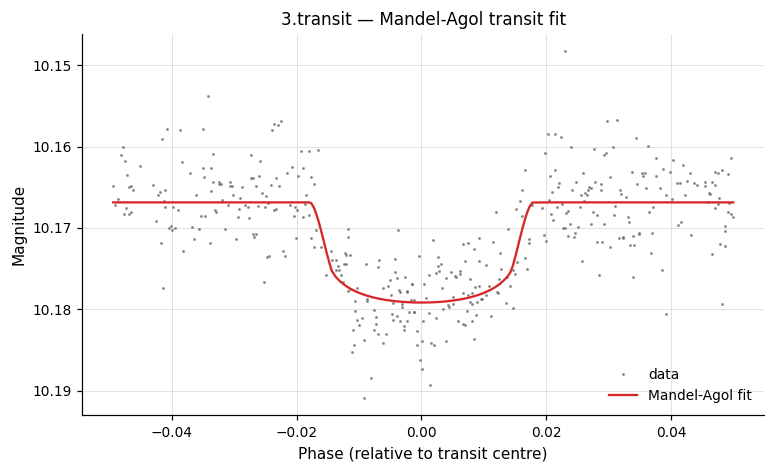
lc = vt.LightCurve.from_file("EXAMPLES/3.transit")

# 1. Run BLS to locate the transit, then 2. fit Mandel-Agol with numeric seeds.
r_bls = lc.BLS(0.5, 5.0, rmin=0.01, rmax=0.1, nbins=200, nfreq=20000, npeaks=1)
P0  = float(r_bls.vars["BLS_Period_1_0"])
Tc0 = float(r_bls.vars["BLS_Tc_1_0"])

result = lc.MandelAgolTransit(
    P0=P0, T00=Tc0,
    r0=0.11, a0=10.0, inclination=90.0,
    ld_type="quad", ld_coeffs=[0.3471, 0.3180],
    fitephem=1, fitr=1, fita=1, fitinclterm=1,
    fite=0, fitomega=0, fitmconst=1,
    save_model=True, save_phcurve=True,
)
print(result.vars["MandelAgolTransit_Period_0"])   # 2.12328176
print(result.vars["MandelAgolTransit_r_0"])        # Rp/R* ~ 0.11
model   = result.files["MandelAgolTransit_model_0"]    # fitted model LC
phcurve = result.files["MandelAgolTransit_phcurve_0"]  # phase-folded model
SoftenedTransit — Softened (trapezoidal) transit
Syntax
cmd.SoftenedTransit(init_params="bls", fitephem=1, fiteta=1,
                    fitcval=1, fitdelta=1, fitmconst=1,
                    correct_lc=False, save_model=False,
                    fit_harm=0, fit_harm_method=None,
                    fit_harm_nharm=None, fit_harm_nsubharm=None)
Description
Fit a Protopapas, Jiménez & Alcock (2005) "softened" trapezoidal transit model. init_params can be "bls" or "blsfixper" to initialise from a prior BLS / BLSFixPer result, "ls" or "aov" to seed the period from the corresponding periodogram, or a tuple (P0, T00, eta0, delta0, mconst0, cval0) of explicit numeric initial values.
CLI equivalent: -SoftenedTransit.
Back-reference seeding from BLS / BLSFixPer
init_params="bls" (or "blsfixper") seeds four fields from the prior result: period, T0, eta (= Qtran), and delta (= Depth). This works both in a single Pipeline and across chain steps. Batch-chain mode is not supported for the multi-field "bls" / "blsfixper" case (would require per-LC propagation of four fields); use a single Pipeline invocation for batch runs. "ls" and "aov" seed only the period and work in both single- and batch-chain modes. Missing prior command → LookupError.
Parameters
| Parameter | Type | Description |
|---|---|---|
init_params |
str or tuple |
"bls" / "blsfixper" (multi-field seed), "ls" / "aov" (period-only seed), or a tuple (P0, T00, eta0, delta0, mconst0, cval0) of explicit values. |
fitephem, fiteta, fitcval, fitdelta, fitmconst |
int |
Fit each model parameter (0 = fixed, 1 = free). fitephem controls period and T0 simultaneously. |
correct_lc |
bool |
Subtract the best-fit transit from the LC before passing to the next command. |
save_model |
bool, str, or Output |
Auxiliary file output. True captures as result.files["SoftenedTransit_model_N"]. See Auxiliary output files. |
fit_harm |
int |
Harmonic fitting flag. 0 = no harmonic component (default); when > 0, a harmonic series is fitted simultaneously. |
fit_harm_method |
str or None |
Source of the harmonic period: "aov", "ls", "bls", "list", or "fix". Only used when fit_harm > 0. |
fit_harm_nharm |
int or None |
Number of harmonics for the harmonic component. |
fit_harm_nsubharm |
int or None |
Number of sub-harmonics for the harmonic component. |
Output
Suffix N is the 0-indexed pipeline command position:
| Column | Description |
|---|---|
SoftenedTransit_Period_N |
Best-fit orbital period (days). |
SoftenedTransit_T0_N |
Best-fit mid-transit epoch. |
SoftenedTransit_eta_N |
Best-fit transit-duration parameter. |
SoftenedTransit_cval_N |
Best-fit softening parameter. |
SoftenedTransit_delta_N |
Best-fit transit depth. |
SoftenedTransit_mconst_N |
Best-fit out-of-transit magnitude. |
SoftenedTransit_chi2perdof_N |
Reduced χ² of the best-fit model. |
When save_model is set:
| File key | Description |
|---|---|
result.files["SoftenedTransit_model_N"] |
DataFrame: time-sampled best-fit softened-transit model. |
References
Protopapas, P., Jiménez, R. & Alcock, C. 2005, MNRAS, 362, 460.
Examples
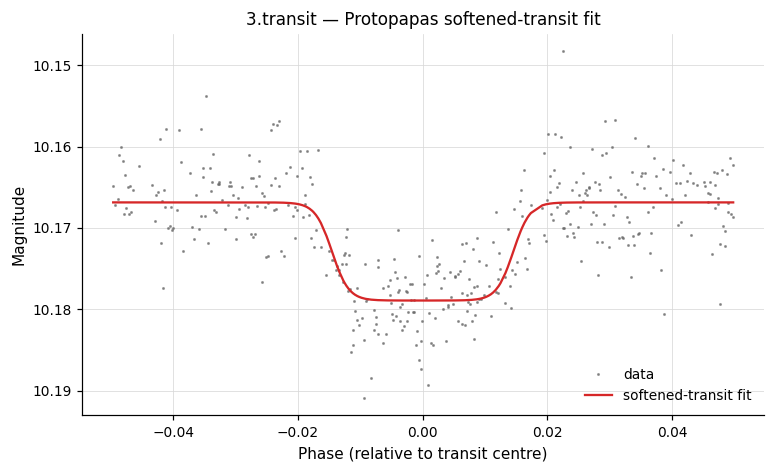
lc = vt.LightCurve.from_file("EXAMPLES/3.transit")

pipe = (vt.Pipeline()
        .BLS(0.5, 5.0, rmin=0.01, rmax=0.1, nbins=200, nfreq=20000, npeaks=1)
        .SoftenedTransit(init_params="bls",
                        fitephem=1, fiteta=1, fitcval=1,
                        fitdelta=1, fitmconst=1,
                        correct_lc=False, save_model=True))
result = pipe.run(lc)
print(result.vars["SoftenedTransit_Period_1"])     # 2.12322112
print(result.vars["SoftenedTransit_chi2perdof_1"])
model = result.files["SoftenedTransit_model_1"]   # SoftenedTransit is at index 1
Starspot — Starspot model
Syntax
cmd.Starspot(period="ls",
             a0=0.1, b0=0.5, alpha0=20.0, i0=85.0,
             chi0=30.0, psi00=0.0, mconst0=0.0,
             fit_period=1, fit_a=1, fit_b=1, fit_alpha=1,
             fit_i=1, fit_chi=1, fit_psi=1, fit_mconst=1,
             correct_lc=False, save_model=False)
Description
Fit a Dorren (1987) single-spot model — a circular, uniform-temperature starspot — to a photometric light curve. Initial parameters a0, b0, alpha0, i0, chi0, psi00 are as defined in Dorren 1987 (spot fractional radius, latitude in radians, longitude in degrees, stellar inclination, spot contrast, phase offset). Set mconst0 negative to estimate the unspotted magnitude automatically.
CLI equivalent: -Starspot.
Deprecated
The underlying -Starspot command is deprecated as of VARTOOLS 1.3. Use the macula extension command instead.
Parameters
| Parameter | Type | Description |
|---|---|---|
period |
float or str |
Starting period. Can be a number or "ls", "aov", or "fixcolumn NAME" to inherit from a prior pipeline command. These back-references resolve correctly both in a single Pipeline and across chain steps (e.g. lc.aov(...).Starspot(period="aov")). Missing prior command → LookupError. |
a0 |
float |
Initial spot fractional radius (default 0.1). |
b0 |
float |
Initial spot latitude in radians (default 0.5). |
alpha0 |
float |
Initial spot longitude in degrees (default 20.0). |
i0 |
float |
Initial stellar inclination in degrees (default 85.0). |
chi0 |
float |
Initial spot contrast (default 30.0). |
psi00 |
float |
Initial spot phase offset (default 0.0). |
mconst0 |
float |
Initial magnitude offset (default 0.0; negative ⇒ estimate from data). |
fit_period |
int |
Fit the period (0 = fixed, 1 = free; default 1). |
fit_a, fit_b, fit_alpha, fit_i, fit_chi, fit_psi, fit_mconst |
int |
Fit each model parameter (0 = fixed, 1 = free; all default 1). |
correct_lc |
bool |
Subtract the best-fit spot model from the LC before passing to the next command. |
save_model |
bool, str, or Output |
Auxiliary file output. True captures as result.files["Starspot_model_N"]. See Auxiliary output files. |
Output
Suffix N is the 0-indexed pipeline command position:
| Column | Description |
|---|---|
Starspot_Period_N |
Best-fit rotation period (days). |
Starspot_a_N |
Best-fit spot fractional radius. |
Starspot_b_N |
Best-fit spot latitude (radians). |
Starspot_alpha_N |
Best-fit spot longitude (degrees). |
Starspot_inclination_N |
Best-fit stellar inclination (degrees). |
Starspot_chi_N |
Best-fit spot contrast. |
Starspot_psi0_N |
Best-fit spot phase offset. |
Starspot_mconst_N |
Best-fit unspotted magnitude. |
Starspot_chi2perdof_N |
Reduced χ² of the best-fit model. |
When save_model is set:
| File key | Description |
|---|---|
result.files["Starspot_model_N"] |
DataFrame: time-sampled best-fit starspot model. |
References
Dorren 1987, ApJ, 320, 756.
Examples
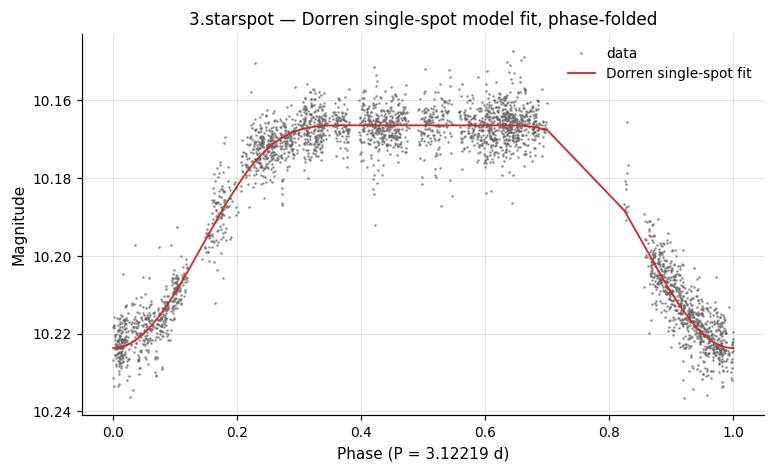
lc = vt.LightCurve.from_file("EXAMPLES/3.starspot")

# Determine rotation period with AOV then fit Dorren starspot model
pipe = (vt.Pipeline()
        .aov(0.1, 10.0, 0.1, 0.01, npeaks=5, nbin=20)
        .Starspot(
            period="aov",
            a0=0.0298, b0=0.08745, alpha0=20.0, i0=85.0,
            chi0=30.0, psi00=0.0, mconst0=-1.0,
            fit_period=1, fit_a=1, fit_b=1, fit_alpha=1,
            fit_i=1, fit_chi=1, fit_psi=1, fit_mconst=1,
            correct_lc=False,
            save_model=True,
        ))
result = pipe.run(lc)
print(result.vars["Starspot_Period_1"])
print(result.vars["Starspot_chi2perdof_1"])
model = result.files["Starspot_model_1"]   # Starspot is at index 1
microlens — Microlensing model
Syntax
cmd.microlens(f0=None, f1=None, u0=None, t0=None, tmax=None,
              correct_lc=False, save_model=False,
              f0_step=None, f0_novary=False,
              f1_step=None, f1_novary=False,
              u0_step=None, u0_novary=False,
              t0_step=None, t0_novary=False,
              tmax_step=None, tmax_novary=False)
Description
Fit a Wozniak et al. (2001) point-source single-lens microlensing model to the light curve using a downhill-simplex optimiser. Each parameter (f0, f1, u0, t0, tmax) can be a float (free-fit initial value), "auto" (vartools auto-estimate), a string passthrough (e.g. "fixcolumn colname", "list column 3"), or None (omit). Use {name}_step to set the initial step size and {name}_novary=True to hold a parameter fixed during fitting.
CLI equivalent: -microlens.
Back-reference via fixcolumn
Each of f0, f1, u0, t0, tmax accepts "fixcolumn NAME" to pull the initial value from an output column of a prior command. This resolves identically in a single Pipeline and across chain steps. In the chained form the column name (not a numeric column index) is required. Missing column in the prior result → LookupError.
Parameters
| Parameter | Type | Description |
|---|---|---|
f0, f1, u0, t0, tmax |
float, str, or None |
Initial values for the five model parameters. Float = free-fit initial value; "auto" = vartools auto-estimate; string passthrough (e.g. "fixcolumn colname", "list column 3"); None = omit. |
f0_step, f1_step, u0_step, t0_step, tmax_step |
float or None |
Initial step sizes for the downhill simplex (per parameter). |
f0_novary, f1_novary, u0_novary, t0_novary, tmax_novary |
bool |
Hold the corresponding parameter fixed at its initial value. |
correct_lc |
bool |
Subtract the best-fit microlens model from the LC before passing to the next command. |
save_model |
bool, str, or Output |
Auxiliary file output. True captures as result.files["microlens_model_N"]. See Auxiliary output files. |
Output
Suffix N is the 0-indexed pipeline command position:
| Column | Description |
|---|---|
Microlens_f0_N |
Best-fit baseline flux. |
Microlens_f1_N |
Best-fit lensed-source flux. |
Microlens_u0_N |
Best-fit minimum impact parameter. |
Microlens_t0_N |
Best-fit Einstein-radius crossing time. |
Microlens_tmax_N |
Best-fit time of peak magnification. |
Microlens_chi2perdof_N |
Reduced χ² of the best-fit model. |
When save_model is set:
| File key | Description |
|---|---|
result.files["microlens_model_N"] |
DataFrame: time-sampled best-fit microlens model. |
References
Wozniak, P. R. et al. 2001, AcA, 51, 175.
Examples
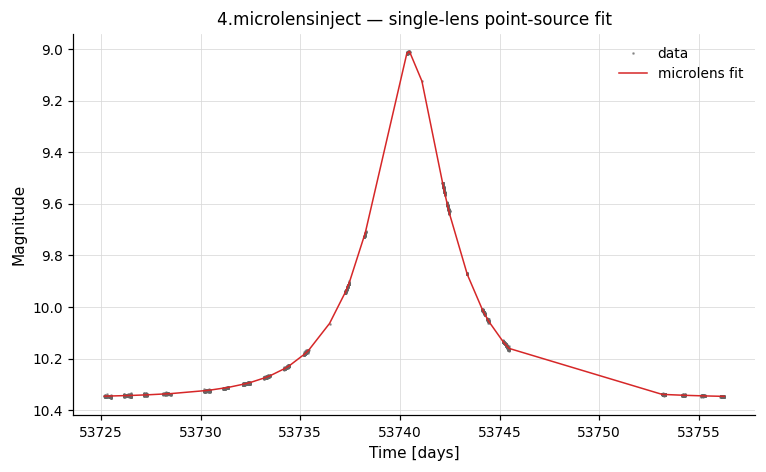
lc = vt.LightCurve.from_file("EXAMPLES/4.microlensinject")

result = lc.microlens(f0="auto", f1="auto", u0="auto",
                      t0="auto", tmax="auto", save_model=True)
print(result.vars["Microlens_u0_0"])
print(result.vars["Microlens_tmax_0"])
print(result.vars["Microlens_chi2perdof_0"])
model = result.files["microlens_model_0"]